Controller
The controller is the NC parser a project reads its programs with: a brand, the machine and control settings that brand assumes, and the coordinate, offset and variable tables an NC program addresses. Setting it up is picking the brand first, then filling in the tables that brand grew.
Where it is
The General Setup page, at /general-setup, reached from the menu bar's Page dropdown. Select
the Controller branch of the Control Tree (/general-setup?tree=equipment/controller); it sits
after Workpiece, and whichever node you select opens its editor below the tree in the same dock.
The branch grows children only with a project open and a controller resolved on it, so a Controller
node standing alone is the state before a project is open rather than a fault; a project file
naming no controller keeps the Fanuc preset. Once a runner resolves, the root's own panel badges the
brand in force and enables an Object Management (⋮) menu, whose Load installs a
.Controller, .SoftNcRunner or .xml runner file in place of the whole controller and whose
Save As writes the current one out, offered as NcRunner.Controller.
Pick the brand first
Select Controller Brand (equipment/controller/machine/brand), pick one of Fanuc,
Siemens, Heidenhain, Syntec and Mazak, and press Apply brand. Until you do the
pick is only staged: Revert drops it, and so does selecting another tree row.
Do it before anything else, because it replaces the whole controller rather than one field:
- The dialect changes. Each brand is a different reader; what its G and M words actually do is NC Dialects.
- The node set changes. The branch is regrown, so nodes the new brand has no concept of stop existing and its own appear.
- Machine settings reset to the new preset's defaults. The runner-owned ones — the tool-change position, block-skip layers, subprogram folders and the macro iteration guards — reset on every apply. The travel limits, rapid feedrates, home reference, M-code declarations and native parameters live in the brand's parameter table and reset only where the switch also sweeps that table; Fanuc and Mazak share one, so a switch between those two leaves them where they are.
- The old brand's own program-data tables are removed — the ones only that brand proxies:
Siemens frames,
$TC_DPoffsets and R parameters, Heidenhain datum presets and shifts. Tool offsets survive every switch, and retained common variables survive among Fanuc, Syntec and Mazak. What is swept does not come back: switching back builds those tables fresh from the new preset's defaults. Carry work-coordinate XYZ (G54…) into the new brand's table, ticked by default, moves the work offsets across — only those, and only for ids the new brand also holds: Fanuc to Siemens keeps G54–G57 and drops the rest.
A brand switch and an Object-Management load are both refused while an NC program is playing — see Playing a Program.
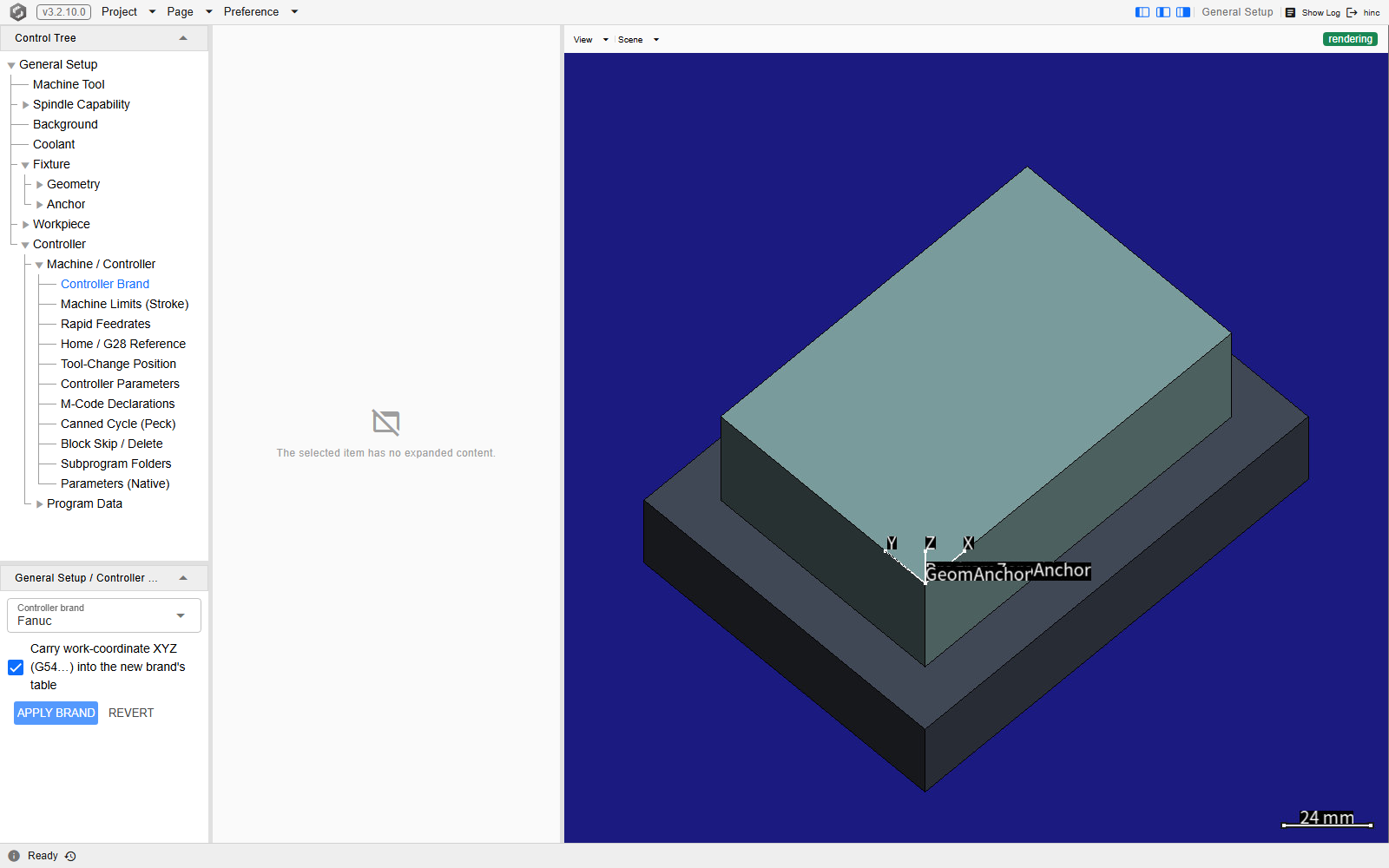
The Controller Brand leaf on a demo project, at
/general-setup?tree=equipment/controller/machine/brand. The machine plane above it is expanded, so
the eleven leaves this brand grows are all visible; the panel below carries the Controller brand
select reading Fanuc, the carry checkbox ticked, and the Apply brand and Revert buttons
that are enabled only while a different brand is staged.
The two planes
Every other node hangs on one of two group stems, and which one it is on says what it describes; selecting a stem lists its children.
| Plane | Tree id | What sits on it |
|---|---|---|
| Machine / Controller | equipment/controller/machine |
What the machine is wired to do: travel limits, rapid feedrates, the home / G28 reference, the tool-change position, the controller parameters in both a grouped and a native form, the peck clearance, M-code declarations, block-skip layers, subprogram folders and, on Siemens, the indexing position tables |
| Program Data | equipment/controller/program-data |
The tables a program reads and writes: work coordinates (G54…) and tool offsets on every brand, plus the brand's own — Siemens frames, $TC_DP offsets and R parameters, Heidenhain datum presets and shifts, Fanuc-family retained common variables |
The machine plane's per-axis rows are driven by the machine tool's chain: every brand preset already declares X, Y and Z, and attaching a machine tool adds that chain's own axes beside them. Program data stays with the project, so loading a controller file of the brand already in force leaves those tables as they are.
Work Coordinates always lists the plain G54–G59 rows its brand's table holds — Siemens seeds
only G54–G57 — and, on Fanuc, Mazak and Syntec, the extended G59.1–G59.9 rows of the
brand-neutral table that sits behind the brand table; it shows the G54.1P and G505–G599 rows
once a value is non-zero or the Show all toggle is on. Each row carries P0, which writes the machine coordinate the
workpiece's program-zero anchor sits at, and M0, which writes machine zero; clicking anywhere in
a row also marks that coordinate on the canvas. Both write into the table; neither moves the part.
The other direction — moving the part so that program zero lands on the offset a row already
holds — is not offered on the runner path: this branch is the runner's own settings face and has
no such control, and the Legacy-Controller screen that used to carry one (Align P0) was removed on
2026-09-11. Placing the part on a recorded offset is done by hand —
Program Zero Alignment.
A table that is not there
A node the active brand has no concept of is never created rather than shown and disabled — Frames
on Fanuc, Retained Common Variables on Siemens, Block Skip / Delete on Heidenhain — and a ?tree=
link naming one does nothing on the wrong brand, so name the brand alongside any id shared. Nor is an
id promised to survive a version change — see Finding Your Way.
Two further rows may differ from a colleague's tree for an unrelated reason: CSV Controller and
CL Controller are separate non-brand controllers, absent until their box in the Preference
dropdown is switched on, and which box is on is a per-device setting — see
Preferences. Unlike a brand-gated node, though, these two are still
reachable by link: a ?tree=equipment/controller-csv or ?tree=equipment/controller-cl mints the
node and selects it whatever the box says, so a shared bookmark never dead-ends.
The Preference menu answers whether you need either of them. Under each of the two checkboxes it reads This project plays CSV / This project plays CL, or Not used by this project, worked out from what the open project actually plays — the kinds its mission commands name, the play verbs its scripts call, and, for CL, a machine chain that can only be driven from CL. Neither node is a setup task in its own right: both are childless leaves with no Object Management, because a CSV or CL pipeline is not loaded, pasted or saved as a file the way a brand controller is. Switching a box on reveals the pipeline's settings; leaving it off on a project that plays neither costs nothing.
See Also
- NC Dialects — what each brand's G and M vocabulary actually does, once the brand is picked
- Machine Tool — the chain whose axes fill the per-axis rows on the machine plane
- Program Zero Alignment — the other half of a work offset: where program zero sits on the workpiece
- Setup — the rest of the pre-simulation configuration