Preferences
The settings that follow the application rather than the project are kept on two sides: the service, where one value serves every browser signed in to it, and the browser, for the device it is sitting at. The Preference menu carries four of them — the language, the physics switch and the two controller checkboxes — and the rest are reached from the panel each one belongs to. Which side keeps a setting is the thing worth knowing about it, because that is what decides who else sees the change.
Where it is
The Preference dropdown on the menu bar, after Project and Page. It carries no OK and no Cancel: every control commits the moment it is pressed. Picking a language closes the language submenu and leaves the dropdown itself open, exactly as the checkboxes do; nothing in the dropdown commits on a close. A setting the service refuses is rolled back in the menu, so the dropdown never shows a value that did not take — the refusal arrives separately, as a message naming what failed.
What the dropdown carries
Language opens a submenu of the codes the service offers, each row carrying a language's own name
over the code that names it — English over en, and the two Chinese scripts over zh-Hans and
zh-Hant. The caption on the parent row is the language in force. Picking one re-resolves the
interface immediately and without navigating, which is why the confirmation message already reads in
the language just chosen. The service keeps this one.
Show Physics Options reveals the physics-only parts of two editors, named under Making a physics change take below, and switches the cutter drawn on the Tool House canvas and on the Execution page's CWE canvas from a plain bounding shape to its detailed flute geometry. The service reports whether the physics feature is licensed alongside the setting itself, and without that licence the checkbox is drawn disabled and clear, with nothing in the menu saying more about why. Where the licence is present the setting starts on: a service that has never had a preference saved reports it as on. The service keeps this one too.
CSV Controller and CL Controller each add a node of their own to the General Setup tree once a project is open — with no project open neither node is built, whatever the boxes say. Both are kept by the browser, are clear by default, and are never sent to the service. The caption under each box says whether the open project actually plays that kind — This project plays CSV, or Not used by this project — and is blank when no project is open and when the service cannot say; it is read when the menu opens, so it answers for whatever project is open at that moment.
What is kept where
One service holds one set of values. There is nothing per account: two people signed in under different names read and write the same language, the same physics setting, the same everything else on this side. A change one browser makes is what the next browser to ask will be told. What the service keeps this way is the language, the physics setting, the properties the Execution page lists for a selected step, which of that page's charts, its Session Messages panel and its Step Properties panel are switched on, the General Setup canvas's display options including the work coordinate its marker draws, and the graphic cache budget.
The browser keeps the arrangement of the screen in front of it. That is the two tree pages' layout — which columns are shown, how wide the docks are and how the right-hand dock is divided between its two columns, how tall the editor row under each tree is, which tree nodes are left unfolded, which node each tree page reopens on, the heights dragged between stacked panels, the two shared chart legend widths and the shared strip-chart x-axis mode — together with the two controller checkboxes above, and the File Explorer's editor pane, its split, its auto-save and its sort order. Three of the Execution page's panels sit on this side rather than with that page's others: the 3D Rendering Canvas, CWE and Sentence Syntax. The browser also holds a copy of the language, used only to paint the first frame before the service can be asked; the service's value wins every disagreement, so a language changed from another browser shows up here immediately after that first frame.
The graphic cache budget is the exception on the service side. A new budget takes effect at once and applies to every browser on that service, exactly like the rest — but the write stops there. It reaches the service's preference file only when some later preference save writes that file out, so a service stopped before any such save comes back on the budget it had before.
Making a physics change take
Show Physics Options is read while a tree or a tab row is being built, not while one is on screen, so the four routes below are what the tree and the tab row need; the Execution page's CWE canvas re-reads it the next time the selected step changes, while the Tool House canvas fixes the cutter's shape when its rendering connection is made and holds it until that connection is made again. Ticking it therefore changes nothing already built: the tree does not grow the nodes it gates, and the Tool House cutter's section-tab row does not grow the tab, until something builds them again. Folding a branch shut and opening it again is not a rebuild.
Four things do rebuild one:
- Reload the browser. That rebuilds the whole application, every tree included.
- The project under the session changes — New, a Load that picks a different project, Close Project, or a Save As to a location other than the one already open. Every screen the session has built is discarded and built again, and ReLoad does the same on the path already open.
- On Tool House, select a different tool in the left column and come back. The tab row is built for whichever tool is being shown, so moving between two tools rebuilds it twice.
- Edit the structure of a branch and that branch alone is rebuilt — adding, removing or re-kinding a mission command, or installing a different tool house — so a branch being worked on picks the setting up without being asked.
What appears once one of those has happened: in the Execution tree's Mission branch, the Shot Files Output and Optimization Output blocks under a Post-Execution command; and in Tool House, the cutter's Material section tab.
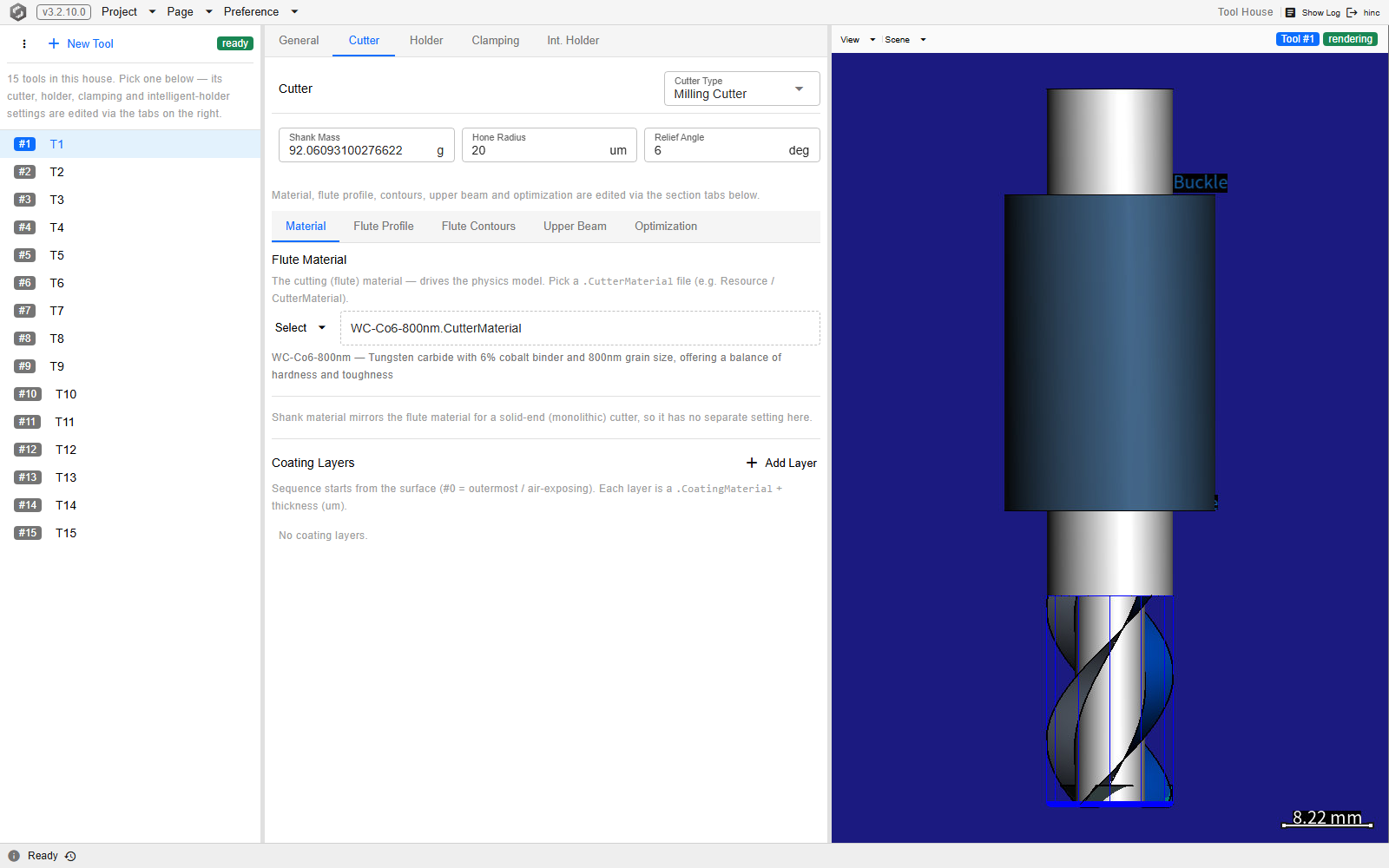
Tool House at /tool-house/1/cutter/material, with the setting on. The tab row above the editor —
General, Cutter, Holder, Clamping, Int. Holder — belongs to the tool; the section
tabs below the Cutter fields belong to the cutter, and Material leads that row only while the
physics setting is on. With it off the row starts at Flute Profile and the address is left alone,
so a link naming the Material tab opens a complete, plausible-looking panel that is not the one it
named.
Settings that live elsewhere
Show Log is a button on the menu bar, not an entry of this dropdown.
Step Present — which properties the Execution page lists for the selected step — opens from the title bar of that page's Step Properties panel, in the Step Info column; the small button there is titled Step Present — choose which properties are displayed. Its Clear and its Reset each ask for confirmation before they act, and its lists of keys are fetched again every time it opens and again whenever the language changes.
Graphic Cache is reached through a panel rather than through the menu bar. On the Execution page, with the canvas-and-messages column shown and the 3D Rendering Canvas panel expanded, that panel's title bar carries a toolbar; its Meshed Geom dropdown holds Graphic Cache, which opens the Graphic Cache (MB) panel — a Lower and an Upper field bounding a Current field and its slider. The toolbar belongs to the canvas and is only lent to the title bar, so collapsing the panel takes the whole toolbar away with it, Graphic Cache included.
Taking settings to another machine
Nothing carries a preference from one installation to another. A second service starts on the built-in defaults — English, and the physics options on wherever the licence allows them — and has no preference file at all until something is saved on it, so an installation that has never had a preference changed has nothing to carry in the first place.
What the browser keeps travels less far still. It belongs to one browser profile on one device, so the same person at a second machine, or in a private window on the same one, finds the tree pages laid out as they come and both controller checkboxes clear.
See Also
- Basics — the rest of what is true on every screen
- The Application Window — the menu bar this dropdown sits on, and what a language switch does to the footer
- Messages and Logs — where the Show Log button goes, since it is not an entry here
- Signing In — why one language setting serves everyone on the service
- Finding Your Way — the tree nodes the two controller checkboxes add, and the branch the physics setting changes