Anchor
Placing the workpiece, the fixture and the tool relative to the machine. Each of them carries named anchors, and the setup task is to give each geometry the transform that puts its anchor where it belongs — four transforms in all, on two branches of the Control Tree.
What an anchor is — a coordinate system rather than a point — and which named buckles hold the scene together is Assembly Anchors. This page is where they are set.
Where it is
The General Setup page, at /general-setup. The transforms hang from the two branches that own the
geometry being placed, each under an Anchor group:
| Branch | Node | What it places |
|---|---|---|
| Fixture | Geom To Tableequipment/fixture/geom-to-table |
The fixture geometry onto the machine's table buckle |
| Fixture | Geom To Workpieceequipment/fixture/geom-to-workpiece |
The workpiece buckle — the place the workpiece attaches — relative to the fixture geometry |
| Workpiece | Geom To Fixtureequipment/workpiece/anchor/geom-to-fixture |
The workpiece geometry onto that workpiece buckle |
| Workpiece | Geom To Program Zeroequipment/workpiece/anchor/geom-to-program-zero |
Program zero, the NC origin, relative to the workpiece geometry |
The tool is not placed here. It arrives on the spindle through the tool house, and how far it stands out of the holder is part of the tool itself — see Cutter.
The order to work in
- Attach a machine tool first. The table buckle the fixture is placed against belongs to the machine chain, so there is nothing to place against until one is loaded — Machine Tool.
- Place the fixture on the table with Geom To Table.
- Place the workpiece on the fixture — Geom To Workpiece on the fixture side, then Geom To Fixture on the workpiece side. A project carrying no fixture skips both: the workpiece is then assembled onto the machine's table buckle directly.
- Set program zero last, once the workpiece is where it belongs. Which direction to align it, and what to align it against, are Program Zero Alignment.
The numbers are on the child node
Each of the four nodes is a kind picker and nothing else. Its panel offers one field, Transformer type, and the editor holding the actual numbers is the child node underneath it — which is why a node that looks empty has an expand arrow beside it.
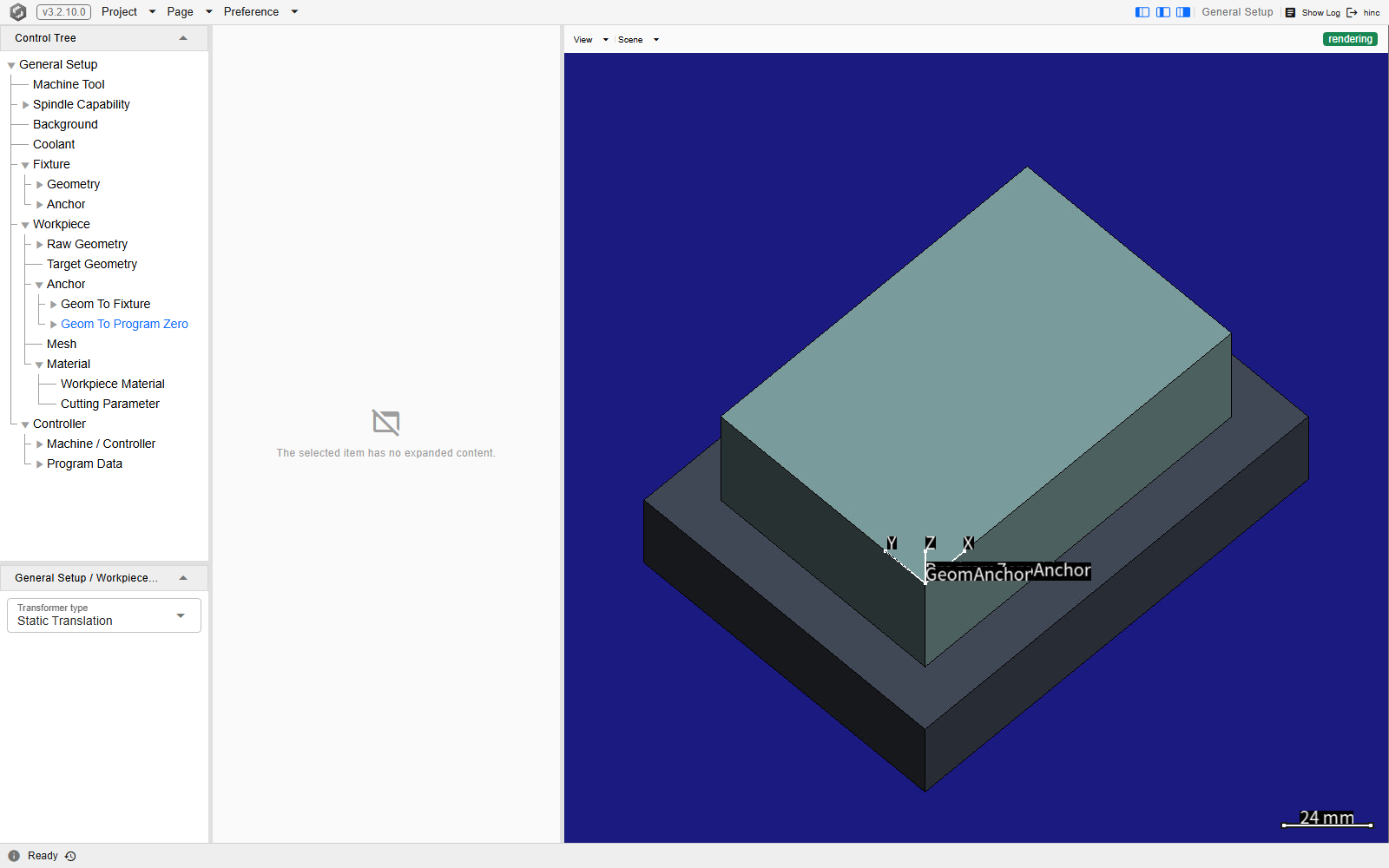
Geom To Program Zero selected on a demo project, at
/general-setup?tree=equipment/workpiece/anchor/geom-to-program-zero. The panel under the tree
carries only Transformer type, reading Static Translation; the node's own child, one level
deeper in the tree, is where that translation's values are typed.
Seven kinds are offered on all four nodes:
| Kind | Use it for |
|---|---|
| Static Translation | A fixed offset. The usual answer for all four. |
| Static Rotation | A fixed turn — stock clamped at an angle, a fixture mounted rotated. |
| Static Freeform | A fixed transform given as a matrix. |
| General Transform | Several transforms composed into one. |
| Dynamic Translation / Dynamic Rotation | A value that moves at run time. These are what a machine's own axes carry; a setup placement is not one of them. |
| No Transform | No offset at all — the two things coincide. |
Changing the kind replaces the editor beneath it, so a value typed under one kind does not carry over to another.
Checking the result
The Scene dropdown above the canvas has an Anchors group that draws what has just been placed: Fixture Geometry Anchor, Workpiece Buckle, Table Buckle, Workpiece Geometry Anchor and Program-Zero Anchor. Turning on the two ends of a transform you have just set is the quickest way to see whether it landed where you meant — a workpiece sitting a plate's thickness below the fixture is obvious as soon as both buckles are drawn.
The same dropdown's Solid group has a Machine checkbox, cleared to begin with, which brings the machine chain into the same scene so the assembly can be checked against the table it is supposed to be sitting on.
See Also
- Assembly Anchors — what an anchor is, and the named buckles the scene is assembled at
- Program Zero Alignment — aligning the program origin once the workpiece is placed
- Machine Tool — the chain that carries the table and spindle anchors
- Fixture — the branch carrying the two fixture transforms named above
- Workpiece — the branch carrying the two workpiece transforms named above, and the rest of the workpiece setup
- Setup — the rest of the pre-simulation configuration