Assembly Anchors
How the parts of a machining scene are held together. Assembly in HiNC is not a placement step but a statement of coincidence: two named anchors are declared equal, and everything they belong to moves so that they are. The buckle anchors below are the joints the machine, fixture, workpiece and tool are assembled at.
Ordered from what an anchor is, to the two chains built out of them.
What an Anchor Is
Anchors are used for assembly purposes. When anchors between geometries coincide, assembly is completed.
Strictly speaking, an Anchor is not a point, but a coordinate system. For two coordinate systems to be equal, their origins must coincide and their rotation directions must be the same.
Note
Anchor Assembly Example
As shown in the figure below, there are two components, each with two anchors, {AnchorA,AnchorB} and {AnchorC,AnchorD} respectively.
The two components are assembled by making AnchorB and AnchorC coincide.

Worktable Anchor and Workpiece Anchor
The machine's worktable end is the chain's w anchor. The fixture carries a TableBuckle that meets it, and a WorkpieceBuckle that the workpiece meets — and the workpiece's own anchor there is named FixtureBuckle, so this joint is made of two anchors each named after the other part.
Only the machine-to-fixture branch carries an editable transform, which is where the fixture is placed on the table. The fixture-to-workpiece branch carries none: it is plain coincidence.
Note
Workpiece Fixture Assembly Example
Workpiece and fixture are assembled by making the fixture's WorkpieceBuckle and the workpiece's FixtureBuckle coincide.
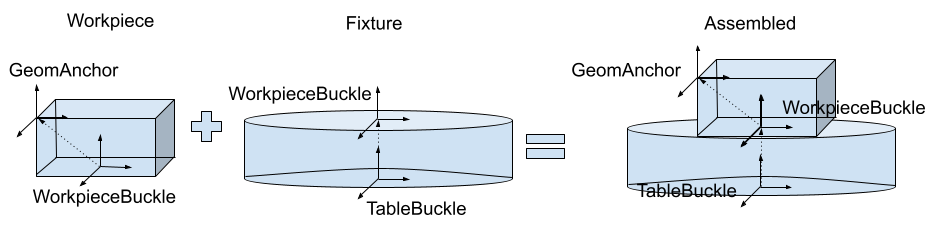
If no fixture is set, both fixture anchors drop out of the chain and the machine's w anchor meets the workpiece's FixtureBuckle directly, carrying the same placement transform.
Spindle Anchor and Cutter Anchor
The machine's tool end is the chain's t anchor, and it meets the SpindleBuckle of the tool as a whole. Inside that tool the holder sits between spindle and cutter: the tool's SpindleBuckle meets the holder's own SpindleBuckle, and the holder's CutterBuckle meets the cutter's buckle anchor (Buckle).
If no holder is set, both holder anchors drop out and the tool's SpindleBuckle meets the cutter's Buckle directly. The machine-side joint is the same either way.
See Also
- Kinematic Topology — the anchor, branch and assembly classes this convention is expressed in
- Anchor — where these relationships are edited in the application
- Program Zero Alignment — aligning the program origin onto these anchors