Antenna-cover injection mould: HiNC's feed optimization takes the moving insert from 12.0 to 7.9 hours, and shows where no feed can help (3-axis)
- Original source
-
Telecom Infra Project, OpenCellular
(github.com/Telecominfraproject/OpenCellular),
folder
hardware/connect-1/: the STEP model and the drawing of part 227-001264, "SHORTY ANTENNA COVER". - Search keywords
OpenCellular 227-001264 SHORTY ANTENNA COVER- Licence
- The repository's hardware documentation is under
CC BY 4.0 (its README and
LICENSE-HARDWARE). This page reproduces nothing of the drawing or the part model: the pictures are rendered by HiNC from the mould insert Tech Coordinate's agent derived, and the charts are drawn from HiNC's per-step results. - Attribution
- OpenCellular Connect-1 hardware, Telecom Infra Project, https://github.com/Telecominfraproject/OpenCellular, CC BY 4.0; provided without warranty. Mould design and machining set-up by Tech Coordinate's agent (changes: shrinkage, parting surface, mould inserts, stock, toolpaths and their optimization).
- About the case
- The accepted programs of the antenna-cover injection mould's moving (B) insert: five programs and 12.0 hours, two thirds of it two micro tools — a Ø2 mm end mill cleaning corners at feeds the agent had slowed by hand, and a Ø1 mm end mill in the rib slots at half the catalogue's feed, the maker's allowance for slotting. Here HiNC's feed optimization takes those two programs over.
The story
The mould's acceptance had shown where the moving insert's time goes: more than half of its twelve hours in two small rest tools, both running cautious feeds. The Ø2 mm program slows to 375 mm/min at every corner where the agent's own rules expect the tool to meet its previous level head-on; the Ø1 mm program runs the catalogue's slotting feed, half its feed per tooth, while HiNC reads its load as light most of the time. An AI agent handed both programs to HiNC's feed optimization and asked what a mould maker would ask: does the optimizer find the corners the hand rules found, how much faster can the micro tools run within their tool-stress target, and can it hold the Ø1 mm tool's bend to the 10 µm the case allowed? It wrote its pass criteria, every setting and its decision rules down first, tried the chain on the first lines of each program, ran four variants on a trimmed patch of the insert — its own hand rules against the optimizer on the same path among them — and then optimized and replayed the whole insert, one program per run. Every number here comes from these plays.
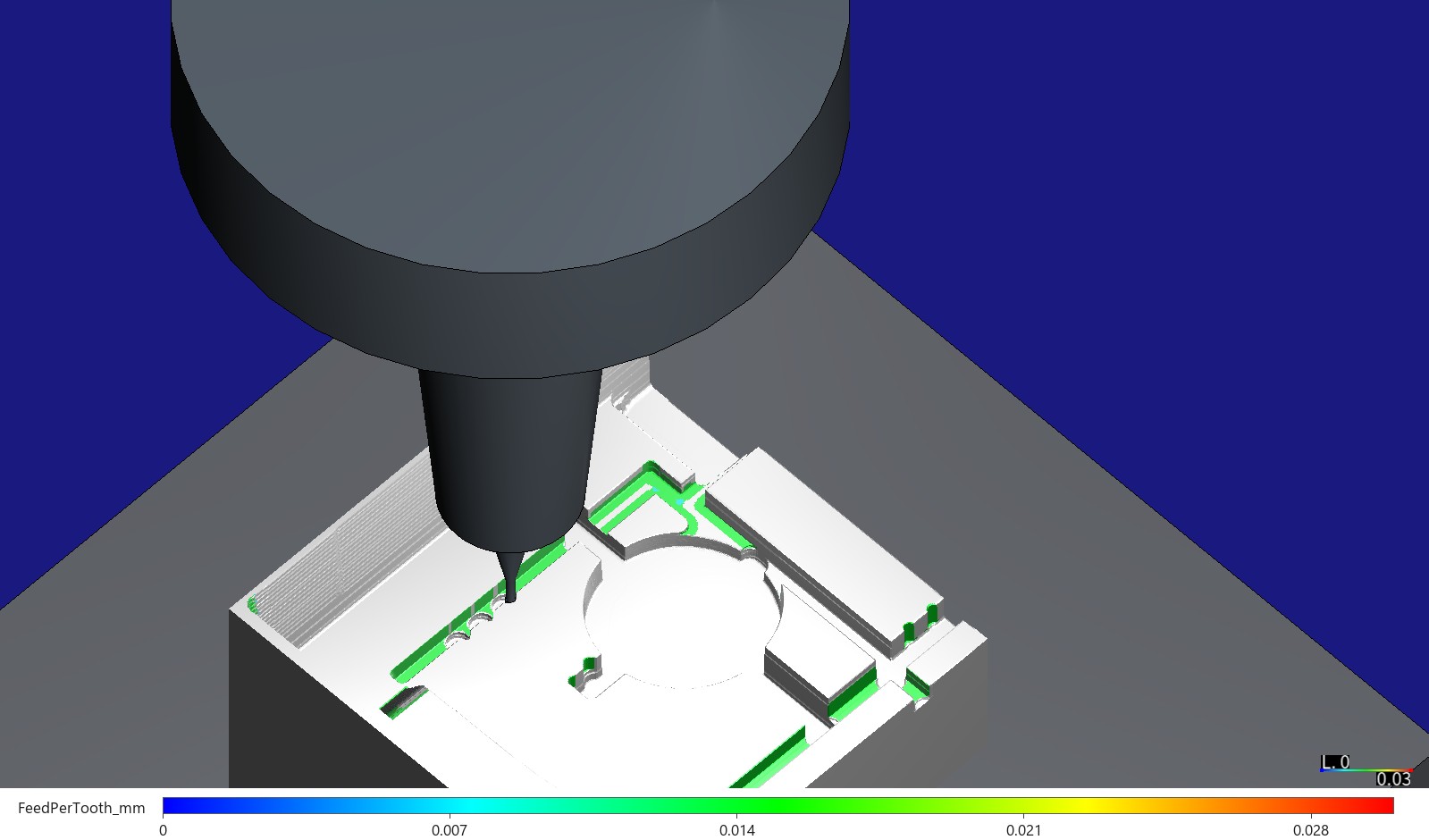
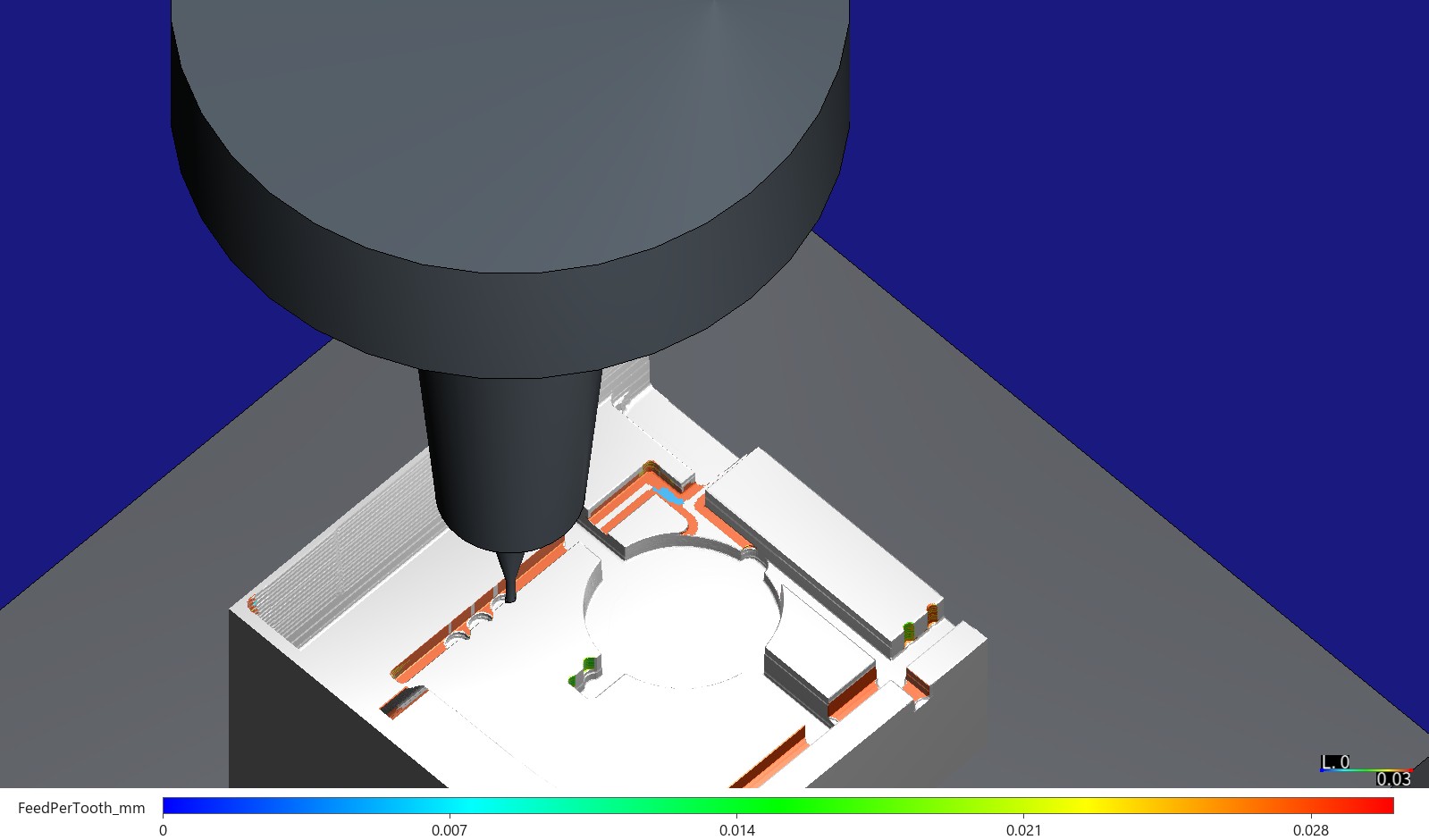
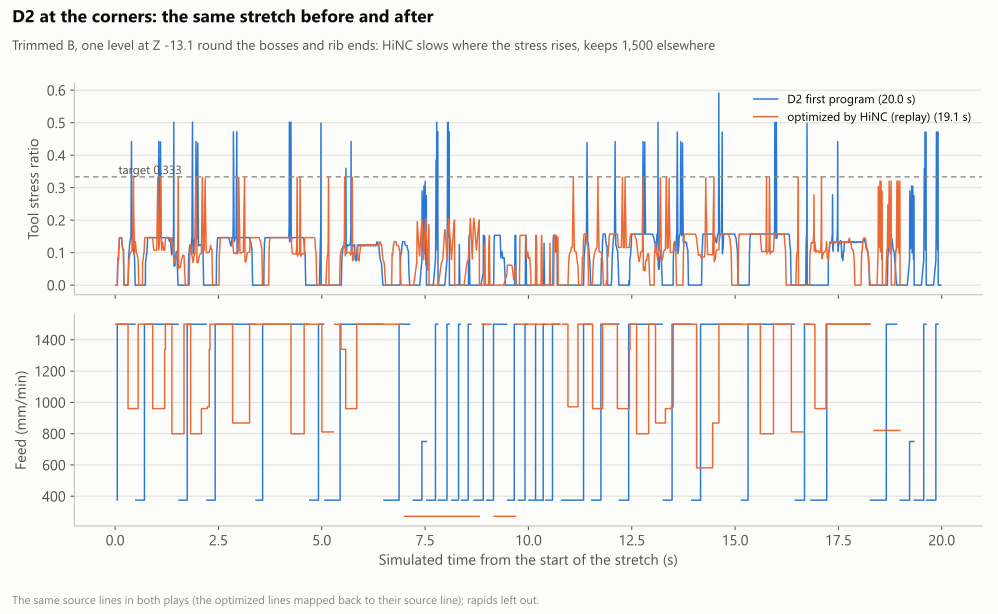
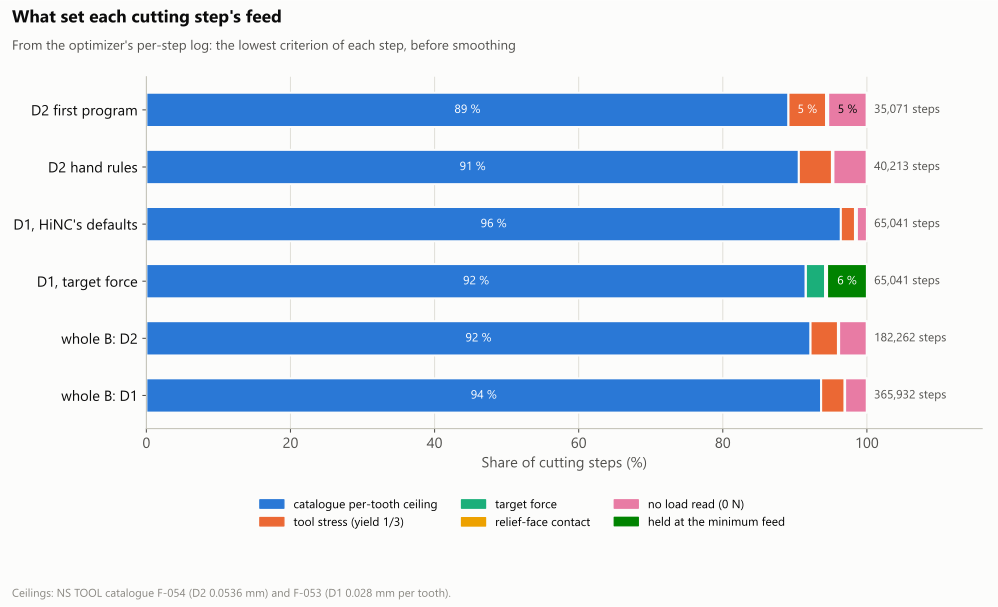
Pictures rendered by HiNC from the insert Tech Coordinate's agent derived from the OpenCellular part (CC BY 4.0). The charts are drawn from HiNC's per-step results and the optimizer's per-step log; the times are ideal-feed estimates, so compare the ratios rather than the absolute times.
| Key number | What it is |
|---|---|
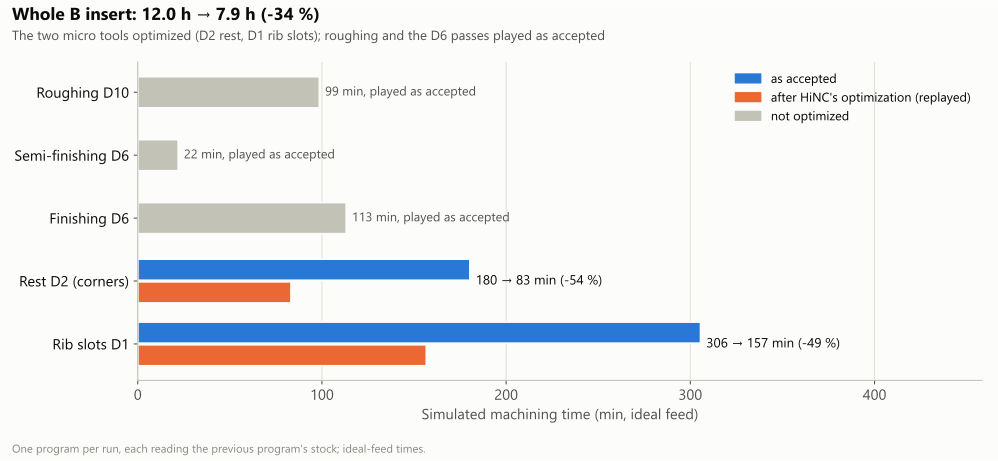
| 12.0 → 7.9 h | the whole moving insert, 719.97 → 474.00 min (−34.2 %), with only the two micro-tool programs optimized |
| 180.4 → 83.3 min | the Ø2 mm corner program (−53.8 %) |
| 305.6 → 156.8 min | the Ø1 mm rib-slot program (−48.7 %) |
| 148 of 246 min | of the time saved, feed through air: ramps and plunges through levels already cut, sent at the air feed instead of the plunge feed; the other 98 min is faster cutting |
| 1.05 → 0.91, 1.07 → 0.70 | the two tools' largest stress ratio; their steps at 0.5 or more fall from 8 to 4 and from 32 to 5 |
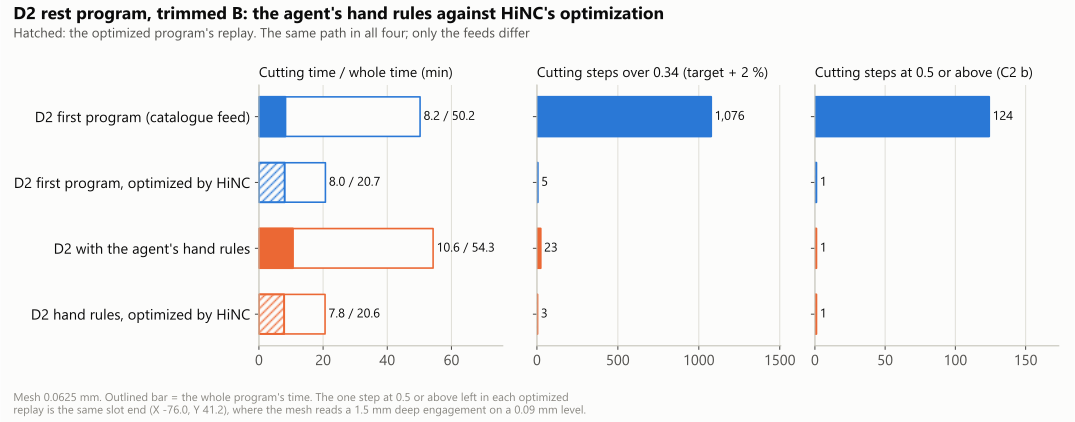
| 20.72 / 20.61 min | the Ø2 mm program on a trimmed patch, optimized without and with the agent's hand corner rules: the same result, one step over 0.5 each |
| 19.5 → 22.3 µm | the Ø1 mm tool's tip deflection at its 99th percentile, against the case's 10 µm: it rises with the feed |
| 3.8 ×, 11.9 µm | a target force for the 10 µm on the trimmed patch: 3.8 times the time, and the 99th percentile still over 10 µm |
| every region alike | the final stock against the design, after the source programs and after the optimized ones |
| 57 min, 35 GB | server time and peak memory of the Ø1 mm program's optimization play on the whole insert |
Four of its twenty dilemmas
Most of the time saved is air
In the first trial the Ø2 mm stretch got 28 % shorter while its time in contact grew. The agent's CAM starts every loop above the stock as it stood before the program and descends at the plunge feed, so on deep levels the tool ramps down through levels already cut. HiNC reads no stock there and sends those moves at the air feed. So the agent splits every time into cutting, feed through air and rapids: of the 246 minutes saved, 148 are air, which a shorter link in the CAM would also save.
Hand rules against the optimizer
For the Ø2 mm tool the agent had written rules to slow it where it meets a corner head-on, at 8 % more time. It wrote the same path again without them and gave both programs to HiNC. Both came out at about 20.7 minutes with one step over a stress ratio of 0.5, at the same slot end: the optimizer found the corners by itself. It runs the light steps at the catalogue's feed, so their typical stress and bend sit higher than with the hand rules, within its target.
A bend limit no feed can reach
The optimizer has no built-in deflection criterion, so the agent carried the case's 10 µm for the Ø1 mm tool as a target force, 4.8 N, from the tool's compliance. 5.5 % of the cutting steps read above it even at the 30 mm/min minimum; the optimizer slowed them and the 2 mm around them to that minimum, the trimmed program took 3.8 times as long, and its 99th percentile still read 11.9 µm. The whole insert ran with the default targets instead, and the miss is reported as a miss.
Three tooth tips over 1
Beside a plateau stands a row of 1 mm teeth. At three V-shaped tips HiNC reads the Ø1 mm tool's whole flute on the tooth and a stress ratio of 1.05 to 1.07. Even the lowest feed does not bring them to a third of yield, so the optimizer writes those three tooth passes at 30 mm/min, 22 times slower; the tips still read 0.69 to 0.70, because the force there barely falls with the feed. A tip like that needs another path, not a lower feed.
The other sixteen are in the full record, nine of them smaller ones in a table; among them an air feed held at the catalogue's feed because the Ø1 mm tool's levels are thinner than HiNC's grid, steps that remove stock while HiNC reads no force on them, and one slot end that a replay reads higher than the optimization play did.
The result
Every optimized program replayed to its last line with no alarm the source programs did not already have, and left the same stock: the final insert matches the design region by region exactly as before. The whole moving insert drops from 12.0 to 7.9 hours. On the Ø2 mm program the gain is mostly time in the air, and the optimizer finds the corners the agent's hand rules had found, so the rules add nothing to its result; on the Ø1 mm program the feed doubles wherever the slot cut is light, which is where the catalogue's slotting allowance is too cautious. Both tools stay within a third of yield on all but a few steps, and the largest stress ratio falls on both. What the optimizer does not do is hold the Ø1 mm tool's bend: it rises with the feed, and no feed brings it to 10 µm in HiNC's model, so that limit needs a change of path or tool. Everything is simulated; no mould was cut.
What it brought
- For a machining engineer: half the micro tools' time and a third of the whole mould insert's taken off without touching the toolpath, the catalogue's feed per tooth as the only ceiling; a clear split of where the time came from, and a clear answer that the deflection limit and the tooth tips are not feed problems.
- For a teacher or a student: what a feed optimizer finds — air the CAM left in its links, and light cuts a general allowance had slowed — and why a bend limit cannot be bought with feed when the force barely falls with it.
- For someone deciding whether to use an agent with HiNC: two accepted micro programs to an optimized insert in one evening and night, about 4.3 hours of server time; criteria and decision rules fixed first, the agent's own hand rules tested against the optimizer, and the failed limits reported as failed.
Read the full case record: the mould's NC optimization
How the mould, its inserts and these programs were made: Antenna-cover injection mould.