SpaceTeamSat1 CubeSat structure: HiNC's feed optimization brings the first CAM program to the spindle target and the deflection limits, 20 % faster than the hand-tuned one (3-axis)
- Original source
- Tim Munhowen (TU Wien Space Team), SpaceTeamSat1 Mechanical Design, Zenodo, version 1.0, 2025, doi:10.5281/zenodo.15482346.
- Search keywords
SpaceTeamSat1 Mechanical Design,zenodo 15482346,CS_Xminus.STEP- Licence
- CC BY 4.0, given as is, without warranty. The plates are the team's models, unchanged; the stock, the clampings, the fixtures, the tools and holders, the programs, their optimization and the machine are the agent's. The pictures below are rendered by HiNC, and the charts are drawn from HiNC's per-step results and the optimizer's per-step log; the drawings are not reproduced.
- Attribution
- SpaceTeamSat1 mechanical design by Tim Munhowen, TU Wien Space Team (Zenodo, doi:10.5281/zenodo.15482346), CC BY 4.0. Machining set-up by Tech Coordinate's agent.
- About the case
- The first clamping of plate X- of the SpaceTeamSat1 CubeSat structure, a student team's 1U satellite frame of six Al 7075 plates: a square frame held in a vise, roughed with a Ø16 mm end mill and finished with Ø6, Ø4 and Ø2 mm cutters, the two smallest on long necks. The agent's first CAM program for it overloaded the spindle and bent the small cutters far past their limits; the program it then tuned by hand held both, but ran 30 % longer. Here HiNC's feed optimization takes both programs over.
The story
Played whole, the agent's first CAM program for this clamping asked the spindle for 1.6 times its short-term rating on the full-width cuts of the Ø16 roughing, and bent the Ø6 and Ø2 finishing cutters 194 and 360 µm, against limits of 25 µm on walls and 50 µm in corners. Over several rounds the agent tuned its CAM by hand — the feed scaled to the stock each piece of path meets, walls in a semi-finish and a final pass, slower round inside arcs — until the program held both, at 30 % more time. Then the same agent handed both programs to HiNC's feed optimization, which rewrites the feed of every line from the loads it reads at each step, and asked two questions a shop would ask: what does the optimizer make of the first program, and how much of the hand revision's time can it win back? It wrote its criteria, settings and predictions down first; carried the deflection limits as target cutting forces drawn from each cutter's compliance, since the optimizer has no deflection criterion of its own; tried every rule on a stock cut down to one corner of the plate; and then optimized and replayed both programs whole, with a third play on the heaviest small-cutter stage of another plate. Every number here comes from these plays.
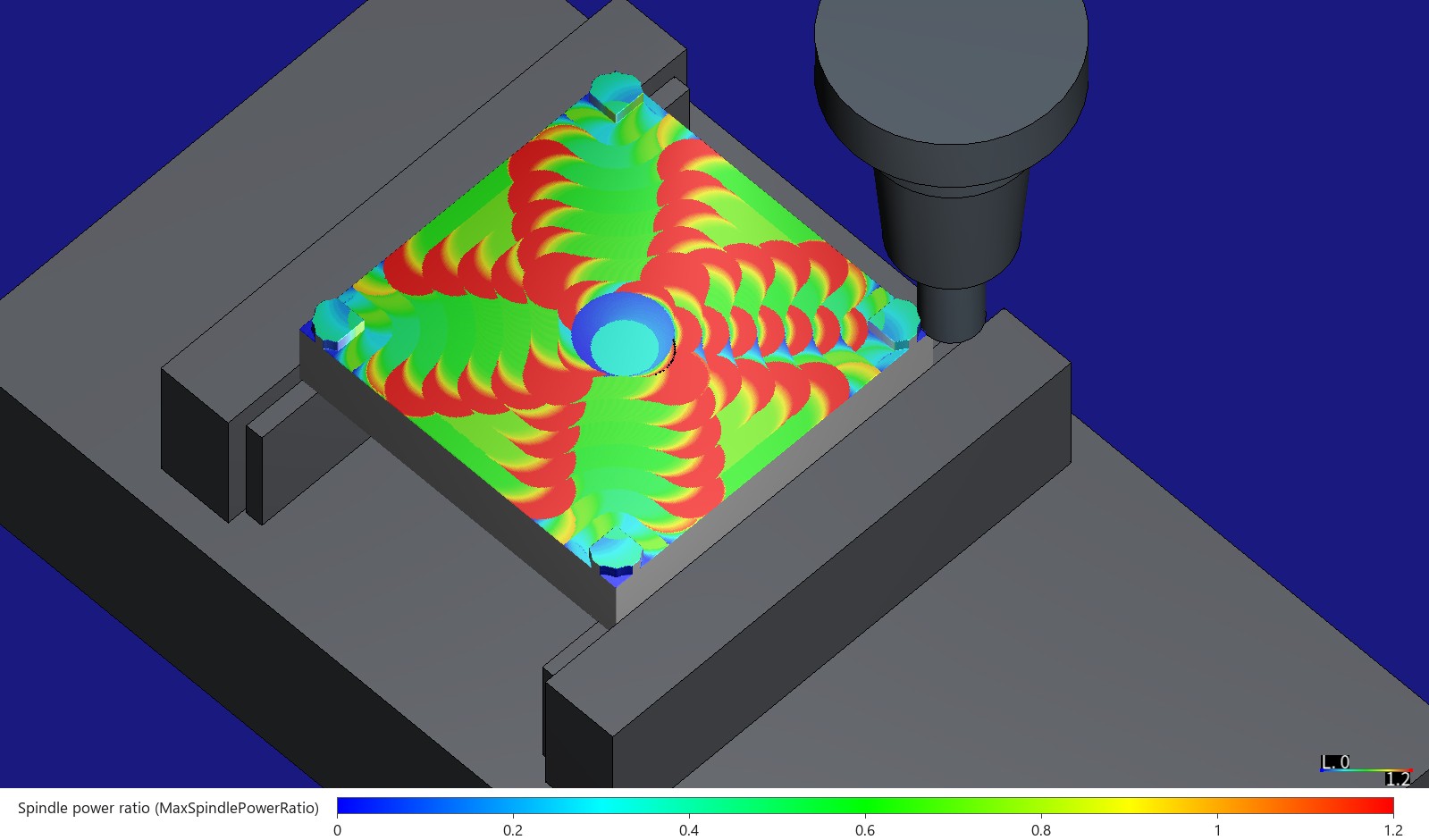
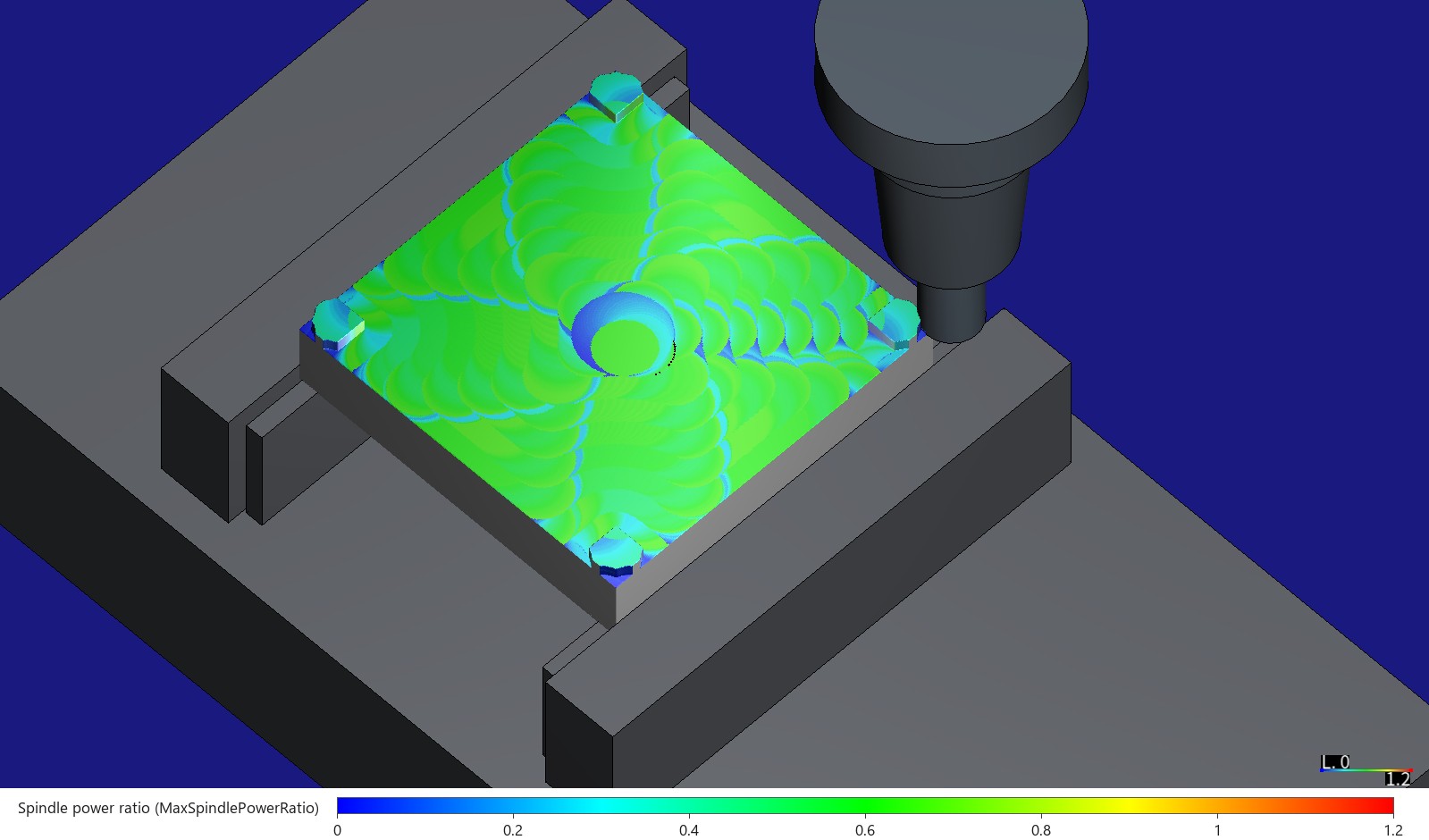
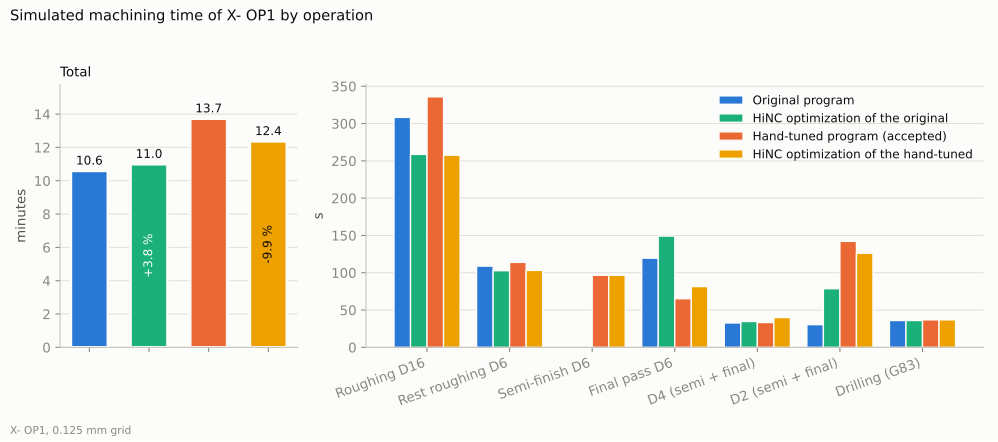
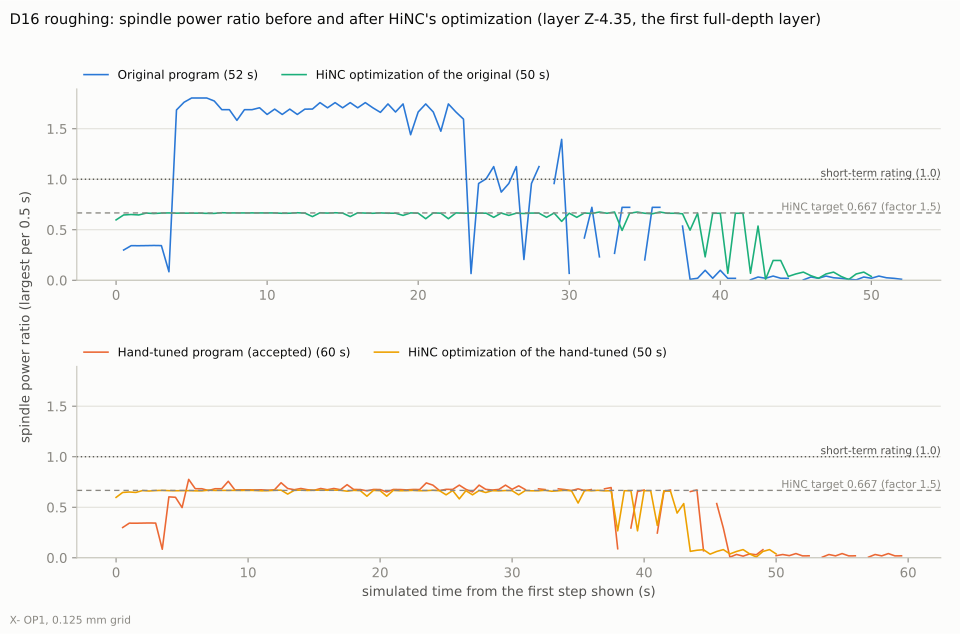
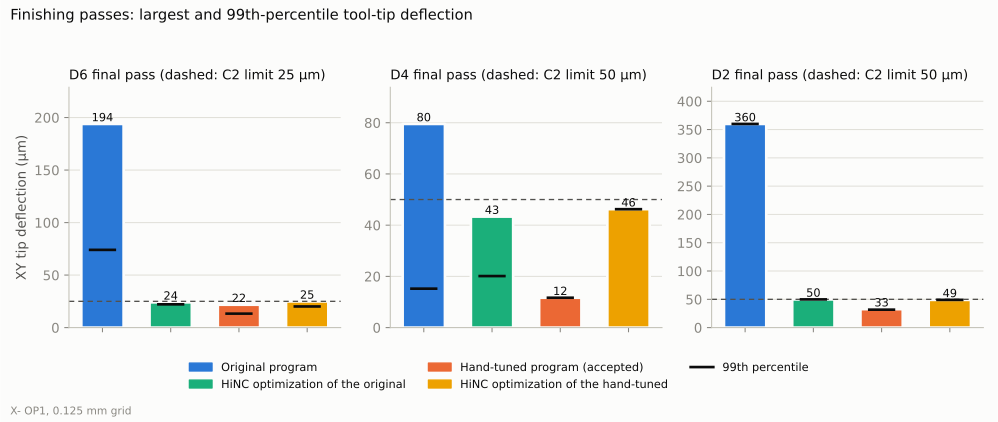
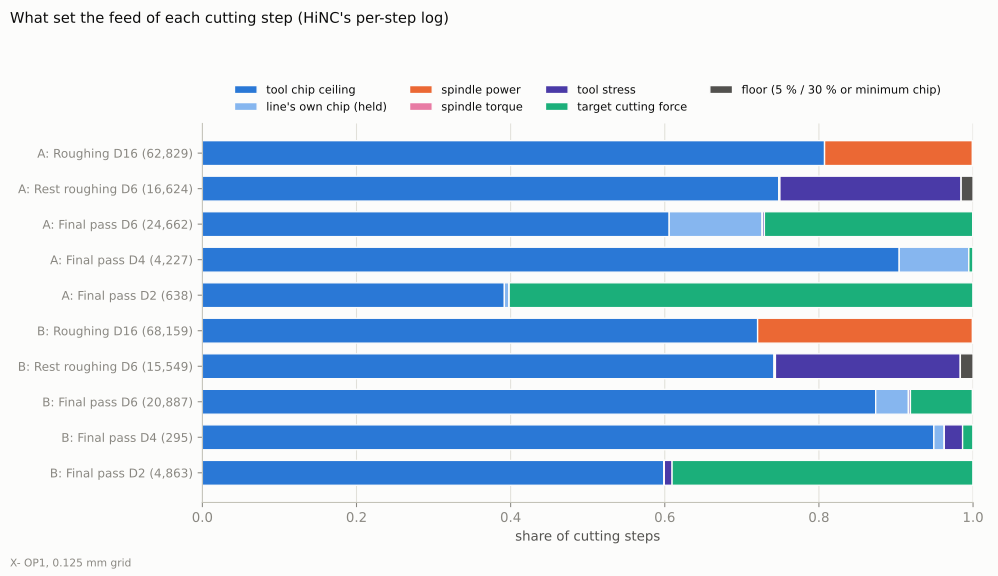
Pictures rendered by HiNC from the TU Wien Space Team's models (CC BY 4.0) with the set-up Tech Coordinate's agent built. The charts are drawn from HiNC's per-step results and the optimizer's per-step log; the times are ideal-feed estimates, so compare the ratios rather than the absolute times.
| Key number | What it is |
|---|---|
| 635.6 → 659.7 s | the first program, optimized by HiNC (+3.8 %): 19.9 % shorter than the hand-tuned program's 823.6 s |
| 823.6 → 741.8 s | the hand-tuned program, optimized (−9.9 %); about −3.3 % had its ramps kept their programmed feed |
| 1.615 → 0.663 | the Ø16 roughing's spindle power ratio at the 99th percentile, against a target of 0.667 of the short-term rating; the first program's 5,844 steps over the rating fall to one ramp reversal that no feed brings down |
| 194 / 80 / 360 → 24 / 43 / 50 µm | the largest tip deflection of the Ø6, Ø4 and Ø2 final passes, first program → optimized, against limits of 25 / 50 / 50 µm — in the model, with the Ø2 cutting 0.001 mm per tooth |
| 55.8 → 50.0 µm | the Ø2's largest bend on the heaviest small-cutter stage of another plate, which also runs 8.6 % faster |
| two thirds | of the hand-tuned program's saving comes from its Ø16 ramps raised to the full chip, a change a shop may not accept |
| 51.6 / 59.6 s | spent at the minimum feed around plunges that remove stock while HiNC reads no force on them |
| 1 µm | the shape: the agent's own height map of the stock agrees within 1 µm on every one of its 17 million nodes, before and after |
| 14 min, 47.5 GiB | server time and peak memory of the heavier optimization play; its replay 14 min and 12.7 GiB |
Four of its seventeen dilemmas
A target force that did more than predicted
The optimizer has no deflection criterion, so the agent carried each limit as a target cutting force: the limit divided by the cutter's compliance. Its plan predicted that the first program's one-pass finishing would stay over the limits even at the minimum feed. It did not: the Ø2's force fell from 42 to 5.7 N as its chip fell from 0.012 to about 0.001 mm. The prediction stands as written and is reported wrong — and a chip that thin rubs on a real machine, so the result holds in the model only.
Two thirds of a saving from the ramps
The plan set no ceiling of their own on the roughing's ramp lines, and HiNC raised the Ø16's ramps from the programmed half chip to the full chip. Splitting the time showed it: about 55 of the 82 seconds taken off the hand-tuned program. The agent reported the result as planned and put an estimate beside it — with the ramps at their programmed feed, about 3 % would be left — rather than credit HiNC with time a shop might put back.
Plunges with stock and no force
Two final passes came out slower than the hand-tuned ones. The feed along one lap showed 11 mm at the minimum feed, and the per-step log traced it to a plunge on which HiNC reads stock removed but no force: there the stress criterion answers the minimum, and the extended distances carry it 2 mm either way. The agent measured the cost — 52 and 60 seconds at the minimum, about 35 and 43 of them avoidable — instead of working round it, so the result still shows HiNC's defaults.
Settings on thousands of lines
The plan first held the hand-tuned program's semi-finish line by line, 3,936 setting lines in the program, and on the corner trial the replay needed 38 GiB where a plain play needed under 2. Two programs that differ only in 200 setting lines showed why: 0.5 against 6.7 GiB for the same steps. The semi-finish was kept whole in three preserved ranges instead, 156 lines, and the whole program played in 47.5 GiB on the shared server.
The other thirteen are in the full record, seven of them smaller ones in a table; among them one step at a ramp reversal that stays over the rating at any feed, points of the optimized roughing up to 16.6 µm off their line, grazes at the air feed narrower than HiNC's grid, and a contact rule too strict for a final pass only 19 mm long.
The result
Every optimized program replayed to its last line with no collision, stroke or rapid-cut alarm, and left the same part: the agent's own height map of the stock agrees within 1 µm on every node, and HiNC's exported parts within four parts in a million in volume. On the first program HiNC holds every full-width cut at the spindle's target and every final pass within its deflection limit in the model, for 3.8 % more time than the first program and 19.9 % less than the hand-tuned one. On the hand-tuned program it takes 9.9 % off within the same limits, two thirds of it on the ramps. On another plate's heaviest Ø2 stage it takes 8.6 % off and brings the cutter's largest bend from 55.8 to 50.0 µm. Everything is simulated; no plate was cut.
What it brought
- For a machining engineer: the first CAM output brought by one optimization play to the limits that took several rounds of hand revision, and faster than the revision; a measured split of where the time comes from — the ramps, the moves through air, the spindle and stress targets — and the two things to look at before such a program runs: chips of a few microns, and ramps at the full chip.
- For a teacher or a student: how a deflection limit becomes a target cutting force through a cutter's compliance, why a model can hold a limit that a real cutter would rub through, and why a time saving has to be traced to its source before it is credited.
- For someone deciding whether to use an agent with HiNC: two existing programs and a third stage taken through trials, optimization plays and replays in about 1.5 hours of plays on a shared server, at most 47.5 GiB; the criteria and predictions written first, and the predictions that missed reported as missed.
Read the full case record: the CubeSat structure's NC optimization
How the plates, their clampings and these two programs were made: SpaceTeamSat1 CubeSat structure.