File Explorer
Working with the files a project is built from, on the server rather than on your own machine. The File Explorer lists what is there, opens text files in an editor beside the listing, and uploads, downloads, renames, copies and deletes them.
Where it is
Its own page, reached from the menu bar's Page → File Explorer, at /util/file-explorer. It
needs no project loaded. The same browser also runs inside every file dialog the application opens
— the Project menu's entries, the Object Management buttons on the Control Tree, and the
Mechanism Builder's Load and Save As actions — so learning it here is learning all of those. Only
the page has the editor beside the listing; a dialog opens with that panel hidden and adds a bar
for confirming the pick.
The three roots
The root selector at the left of the toolbar picks which tree is shown. There are three:
| Root | What it holds |
|---|---|
| Admin | The server's working area. Projects and the shared resource library both live under it. |
| Project | The folder of the currently-loaded project. Listed only while a project is open. |
| Resource | The shipped library — controllers, cutter and workpiece materials, machine tools, spindle capabilities — in a folder named Resource under Admin. |
Everything the browser reports is named relative to the chosen root. Absolute server paths are not shown and are not sent to the browser, so a path copied out of this page names a location inside a root rather than a place on a disk.
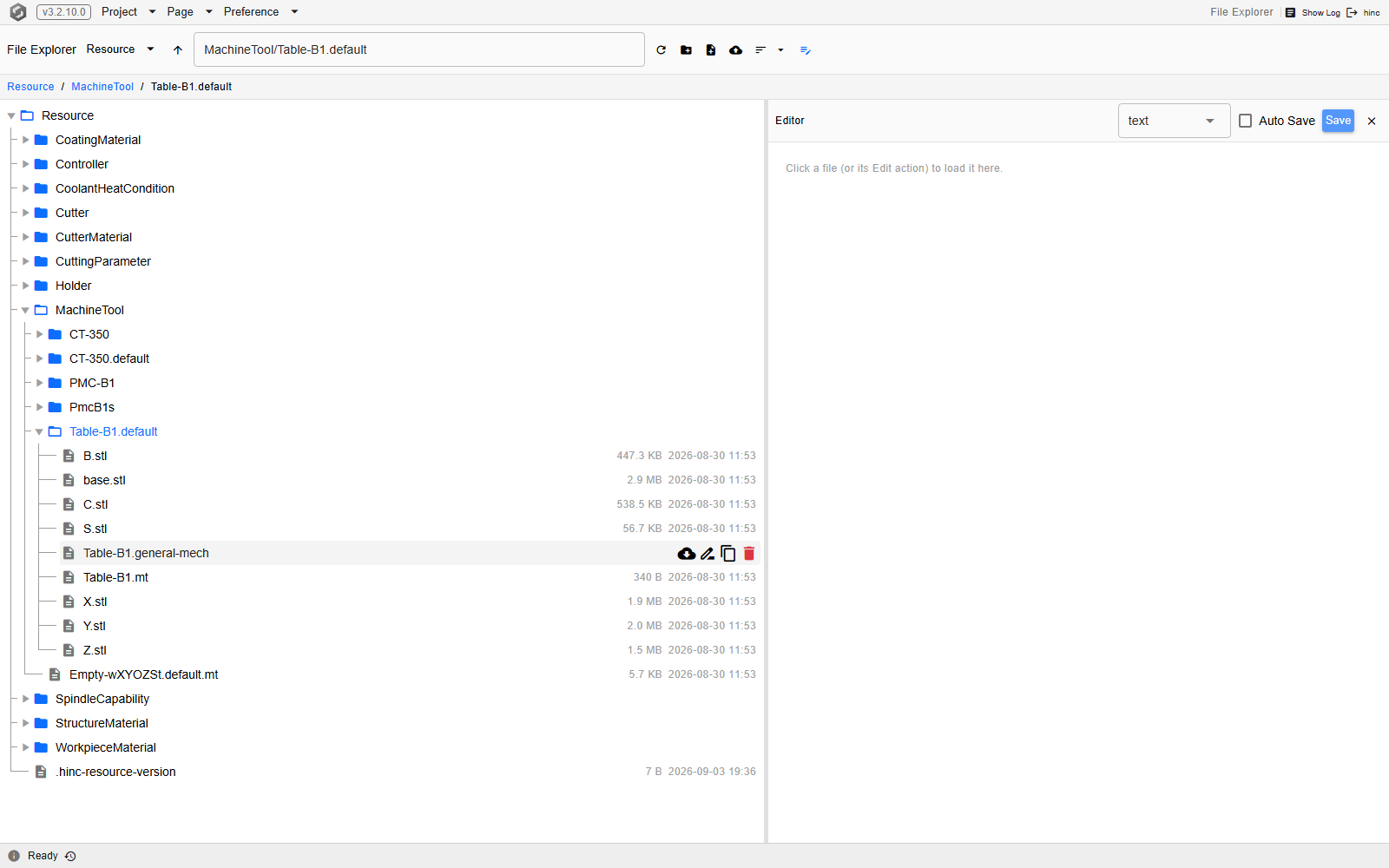
At /util/file-explorer/Resource/MachineTool/Table-B1.default, with the pointer resting on one
row. The action strip appears only on the row under the pointer, and it is laid over the size and
modified columns so nothing on the row moves as it appears.
Finding a file
Three ways in, and they agree with each other:
- Expand the tree. A folder lists its contents the first time it is opened, so a large tree costs nothing until it is walked into.
- Type the path. The path box in the toolbar takes a path relative to the selected root;
Entergoes there. The arrow beside it goes up one level. - Use the address. The location is mirrored into the page address as
/util/file-explorer/<Root>/<path>, so a folder can be bookmarked or pasted to someone else. Browsing rewrites the address, and editing the address drives the browser.
The breadcrumb above the listing goes back up in one click, and the sort control in the toolbar sets the order — by name, size, modified time or type, ascending or descending, with folders kept first or not.
Reading and editing a file
Clicking a text file loads it into the editor on the right; the bar above the editor names the root and the path, and the language selector beside it picks the syntax highlighting. That selector is set from the file's extension when the file opens — a project, machine tool, mechanism, material or milling-parameter file all arrive as XML — and can be changed for the file in hand.
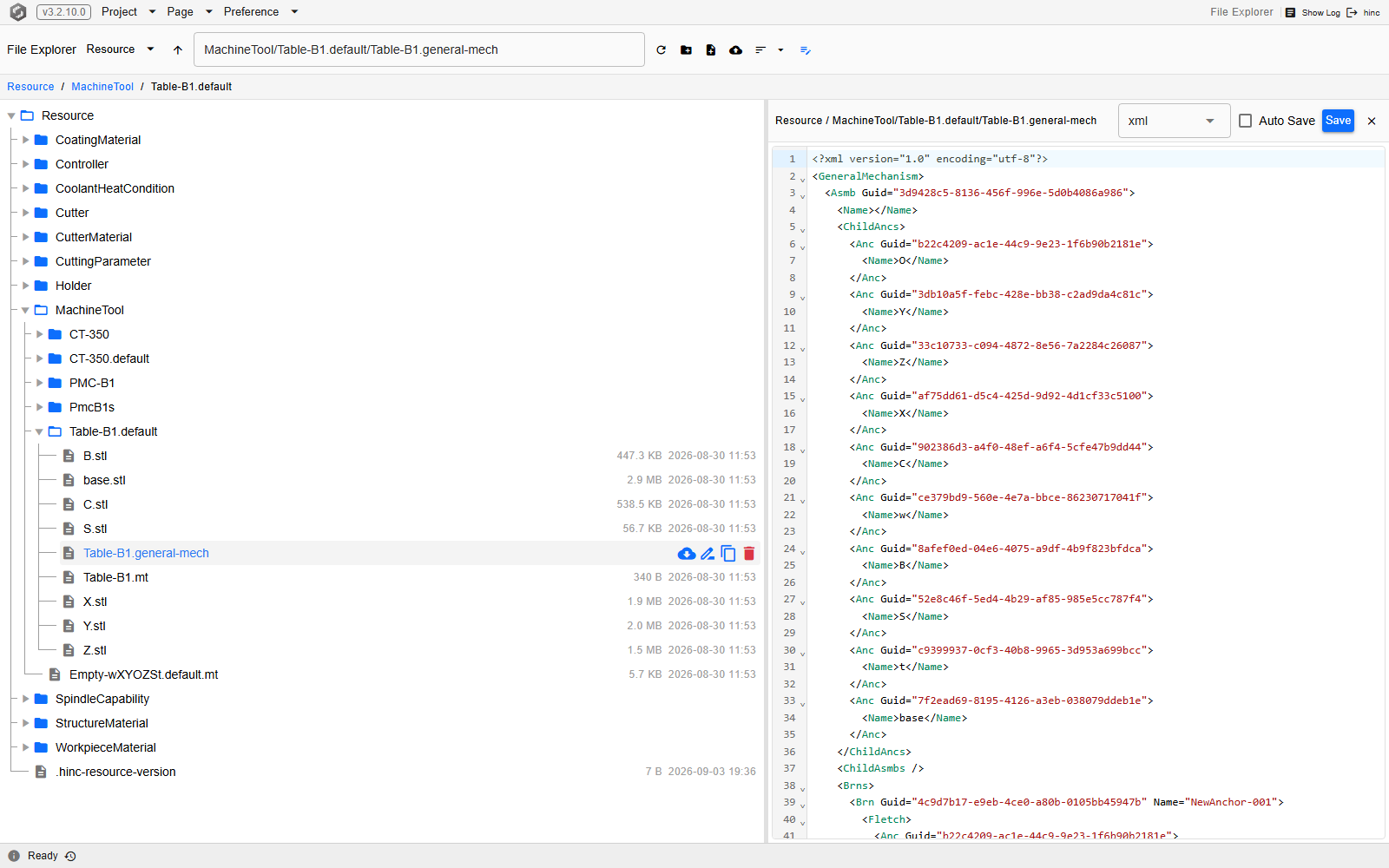
At /util/file-explorer/Resource/MachineTool/Table-B1.default, after clicking the mechanism file.
The pencil button at the right of the toolbar hides and shows this panel; a file clicked while it is
hidden opens nothing, so a double-click is the gesture that opens a file either way.
Edits are not saved until Save is pressed, and the file's name carries a red mark while there are unsaved edits. Ticking Auto Save instead writes shortly after typing stops and disables the button; switching files, closing the panel or leaving the page flushes a pending write first. With Auto Save off, those same three actions ask before discarding unsaved edits.
Binary files do not open here. A click on one reports that it is binary rather than filling the
editor with bytes, and an .stl file opens a 3D preview in the editor's place instead — closing the
preview brings back whatever text was underneath, unsaved edits included.
Renaming and moving
Rename on the row's action strip edits that entry's name. Because the name is written back as a path relative to the folder it is in, the same action moves files:
Tip
Moving by renaming
- Renaming
file1.txttoFolder/file1.txtmoves the file intoFolder. - Renaming
file1.txtinsideFolderto../file1.txtmoves it out to the folder above.
Parent folders that do not exist yet are created. A move that would land outside the root is refused, and so is one whose destination already exists.
A rename cannot move a file from one root to another. To do that, download from one and upload to the other.
The other row actions
- Download saves the file to your own machine. On a folder it becomes Download as ZIP, which packs the folder on the server and sends the archive.
- Extract ZIP, offered on
.ziprows only, unpacks the archive beside itself into a folder named after it. - Duplicate copies the entry next to itself under the first free
-Copy-00…-Copy-19name, and reports that all twenty are taken rather than overwriting one. - Delete needs a double-click to confirm. On a folder it removes the folder and everything under it, and it will not delete a root.
Upload, in the toolbar, sends one file from your own machine into the folder being shown, and overwrites a file of the same name that is already there. New Folder and New File beside it create empty ones; creating a file that already exists fails rather than emptying it.
See Also
- File Explorer Page — the component this page describes: its toolbar, its picker mode, the roots it exposes and the endpoints behind each action
- Mechanism Builder — the other Page-menu utility, whose Load and both Save As actions open this browser as a picker
- Utilities — the other screens the Page menu lists beside this one
- Projects — what the Project root holds, and which of those files a Save As copies