Spindle Capability
Describing the machine's spindle: how much power and torque it delivers at each speed, for how long, and how hot it may get. You fill it in from the machine builder's spindle data sheet, and every spindle number a run reports is measured against it. What the curves mean physically is Spindle Capability; this page is where you enter them.
Where it is
The General Setup page, at /general-setup, reached from the menu bar's Page dropdown. Select the
Spindle Capability branch of the Control Tree (/general-setup?tree=equipment/spindle) — the
equipment item straight after Machine Tool. The tree and the selected node's editor share the left
dock; this branch also fills the page's middle content column with a power and a torque chart,
which stay mounted as you walk its six nodes. Until a project is open the branch is inert: the root
reports No spindle capability attached to this project. and points at the Object Management
(⋮) menu's Load, and each child shows No spindle capability attached. Load one on the Spindle
Capability item. in place of its fields. The selection rides in the address bar as the ?tree= value
the paths below quote; what those ids do and do not promise across versions is
Finding Your Way.
What each child asks for
The root node carries the ⋮ menu first, then the Name and the Note; the five children carry the values, and each edit lands on the project's equipment as you make it.
| Node | What to enter |
|---|---|
Thermal / Energy.../thermal |
Energy Efficiency, the output / input power ratio between 0 and 1; and the Working Temperature Upper Boundary in °C, the housing temperature the spindle is rated to work up to. |
Gear Shift.../gear-shift |
Whether the spindle has a gear-shift mechanism (L/H), and the Gear Shift Spindle Speed in rpm at which it changes range. Leaving the box clear states a single-range spindle; the speed field stays disabled. |
Dry-Run Coefficients.../dry-run |
The Friction Power Coefficient (mW/rpm) and the Windage Power Coefficient (pW/rpm³), the spindle's dry-run idle power — the two terms and where each dominates are Spindle Capability. |
Power Contours.../power |
One kW-against-rpm curve per duty rating. |
Torque Contours.../torque |
The same curves, in Nm. |
Entering a contour
- Select Power Contours or Torque Contours. Add asks for a workable duration in minutes, pre-filled with 60 — clear the field for the continuous curve — and starts the new curve as a copy of the selected one.
- Pick the curve to edit in the Contour selector, which names each by its duration and the unlimited one Continuous; its pencil button re-opens that duration, its delete button removes the curve, and a chip click on the chart selects one just as the selector does.
- The table below is the curve itself: one row per spindle speed and value, an insert button that clones a row, a double-click that removes one, and a chart that redraws on every edit.
The delete button beside the pencil removes the whole selected curve. It is disabled while only one curve is left, so an axis that has curves cannot be emptied from here.
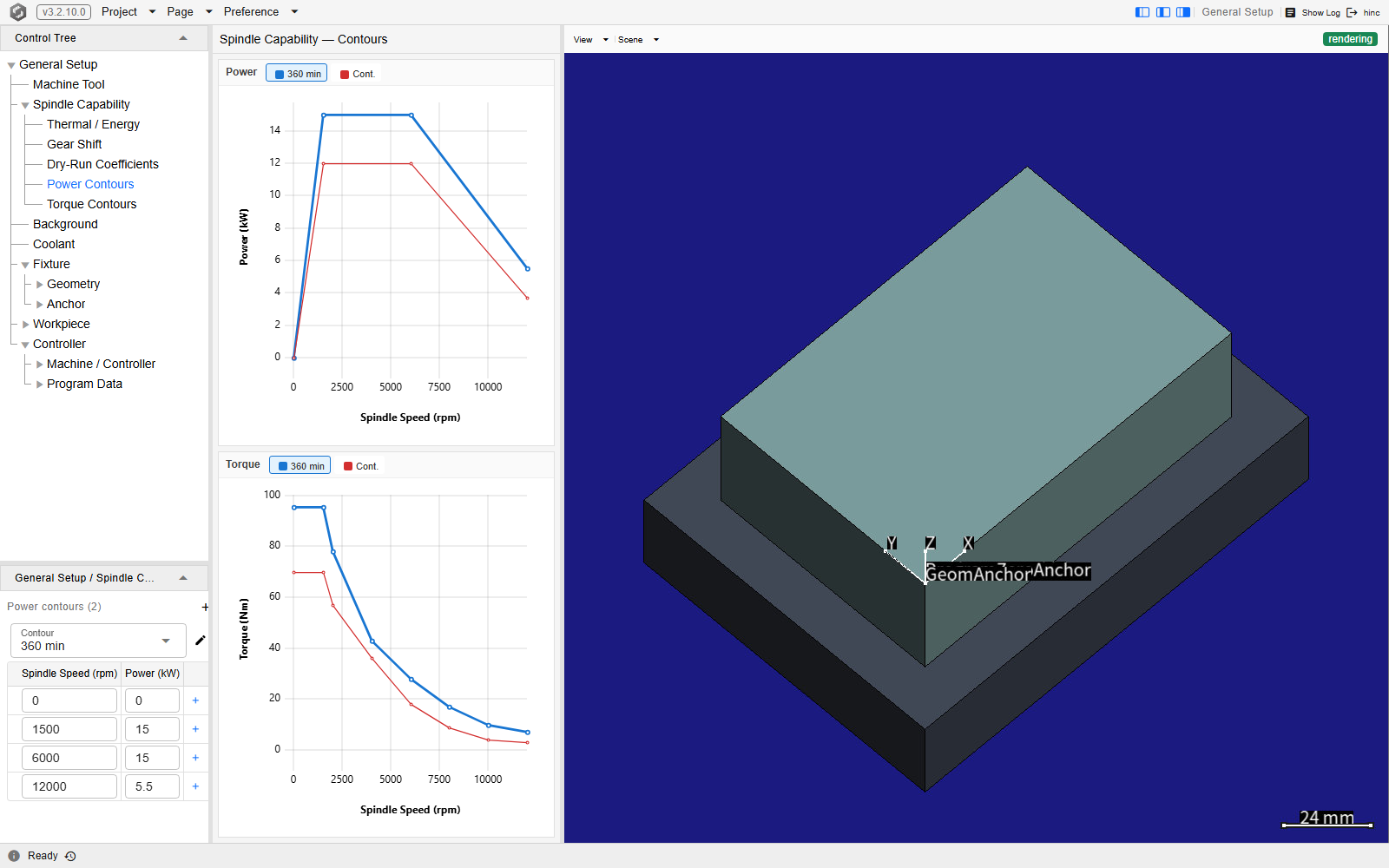
Power Contours selected on a demo project, at /general-setup?tree=equipment/spindle/power. The
tree shows the branch's five children; the middle column carries the pair of charts, which stay put
as you walk between those children; and the panel under the tree is the editor for one curve —
Power contours (2) with its Add button, the Contour selector reading 360 min, and the
four rows of that curve. The chart legends carry one chip per curve, 360 min and Cont., and a
click on a chip moves the editor to that curve.
Where the numbers come from
The machine's or spindle's spec sheet, as the speed–power–torque diagram with the duty ratings printed on it; which printed rating becomes which curve is Spindle Capability, which shows the mapping against a real datasheet chart. The default energy efficiency of 0.4 is the conversion HiNC's power figures were validated at, in Spindle Power Evaluation; what to ask the machine owner for is Project Data Checklist.
The two dry-run coefficients are the ones a datasheet almost never prints. Their defaults — 4.82 mW/rpm of friction and 90 pW/rpm³ of windage — are estimated from published measurements of comparable spindles rather than measured on yours, and they are a reasonable place to leave the field unless you have run the spindle empty and measured its idle draw.
Leaving the branch alone is a choice rather than a blank: a project never given a capability carries a stand-in — the TMV-720A-STD-8000RPM spindle, the same curves as one of the three shipped files, so its name is what the root node shows: 15-minute, 60-minute and continuous curves on each axis, topping out at 8000 rpm, with 0.4 efficiency and a 65 °C ceiling. That is fine for light cuts in small or soft stock. Near the machine's limit it is the wrong envelope, and everything measured against it inherits the error — the spindle torque, power and temperature ratios the run charts, and the feed the optimizer assigns under the spindle safety factors, which are Machine Condition and Safety Factors.
Loading and saving
The root node's ⋮ menu is the branch's whole file surface. The capability is stored in the project, so one already carrying the right spindle needs no file at all; Copy, Paste and XML Mode move it as XML, and an XML Apply installs exactly as a Load does.
- Load browses the server for a
.SpindleCapabilityor.xmlfile — the project or administrator directory, the latter carrying the shipped resource library where three ready-made capabilities are installed. It replaces the capability outright; the branch and the charts reload onto the new one. - Save As writes the current capability out, offered as
SpindleCapability.xmlin the project folder: how a spindle you have tuned becomes reusable in the next project.
See Also
- Spindle Capability — what these curves mean, and how the run's spindle ratios and temperature come out of them
- Project Data Checklist — the data to collect from the machine owner before filling this branch in
- Machine Tool — the machine whose spindle this describes
- Setup — the rest of the pre-simulation configuration