Cutting Force Anomaly Cases
Both cases below cost a customer yield, and in both the cause was invisible on the machine and unmistakable in simulation. They are worth reading together, because they fail the same way: an intermittent force spike far outside normal cutting, at a location that moves.
Case I — Face Milling Into a Thin Workpiece
A face milling operation, not fully entering from the side, produced forces 10 to 30 times normal cutting.
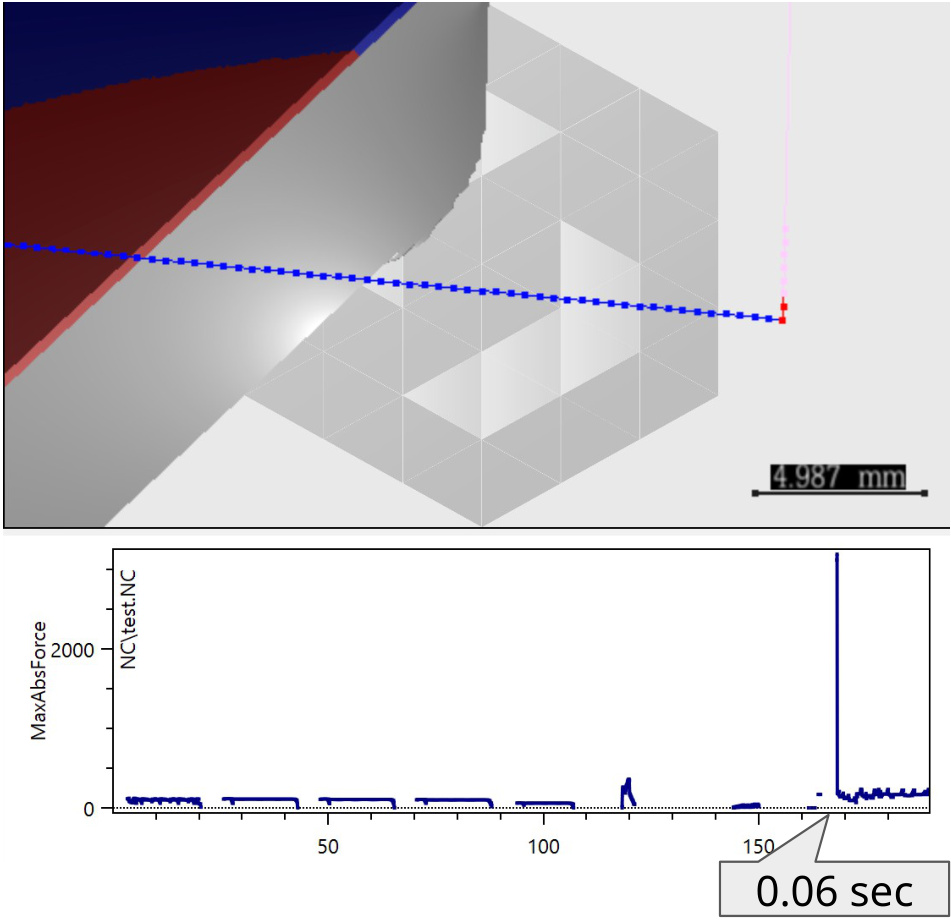
The engineers first suspected the clamping setup. The cause was in the NC: one face milling operation, inside an extensive program, moved straight down in a way that let the flute rotate into the workpiece at a critical moment. Because the impact depended on rotational phase, some runs completed cleanly, which is exactly what made the clamping hypothesis look plausible. The result was severe clamping instability and significant yield loss, and the impact was too brief to catch by watching.
Case II — Impeller, Medium Milling
A toolpath interference where the front and back blades connect produced 40 times normal cutting force, and a high probability of tool breakage.
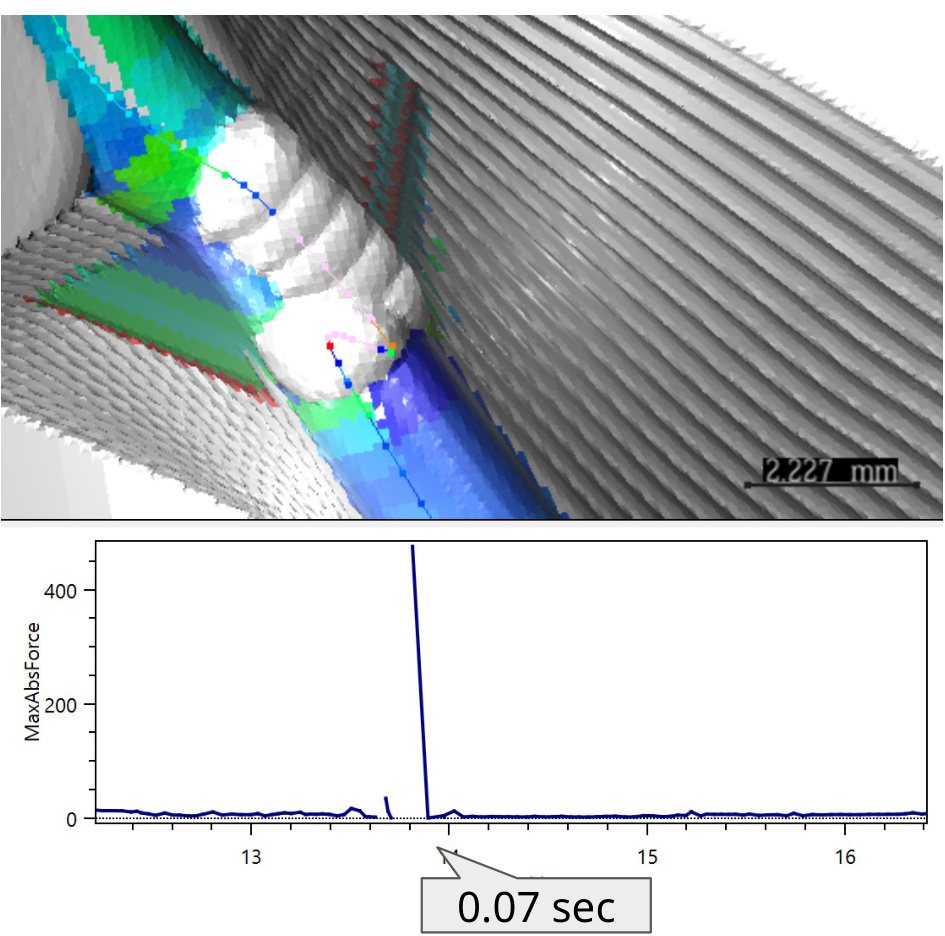
Here too the root cause resisted diagnosis on the floor: the error occurred at inconsistent locations, so no single operation looked guilty.
Why Simulation Finds Them
The forces involved — tens of times average — are an order of magnitude outside the 10%–25% error band the simulation carries between tool types. That gap is what makes these detectable rather than debatable: nothing about model accuracy could produce a 40× reading.
The pattern to recognise, in both cases: intermittent, phase-dependent, and located where a person is not looking. Those are precisely the properties that make a problem survive on a shop floor, and precisely the ones a per-step simulation is indifferent to.
See Also
- Cutting Force and Torque Validation — the error ranges these forces sit far outside
- Evaluating Process Machinability — the ratios that flag a step like these before it runs