Probabilistic Peak: Why a Cut Passes Most of the Time and Occasionally Cracks the Cutter
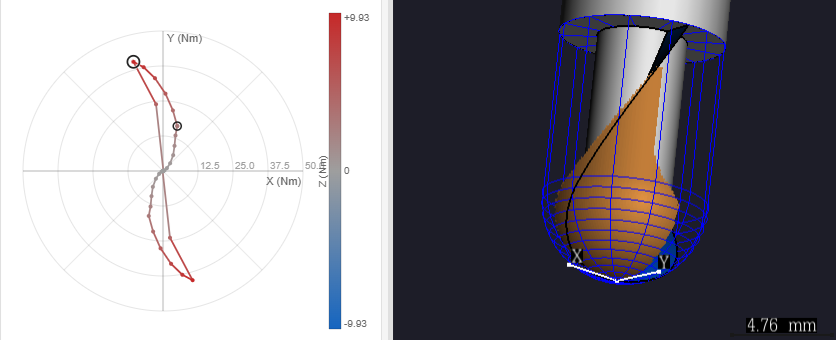 Left — spindle-moment dartboard. The
 (Mx, My) moment-vector tip is drawn as a closed
locus over one spindle revolution, coloured by the axial moment Mz; the concentric rings
are moment magnitude (Nm). For most of the revolution the locus stays near the centre —
small flute–workpiece contact length, small moment. One narrow lobe stretches out to the
outer rings: the angle where the contact length spikes and produces the large force that
can crack the flute. Right — the 3D engagement at that high-load phase, showing the flute
deeply engaged with the workpiece.
The Mechanism
The flute–workpiece contact length is small for most spindle angles and spikes only inside one narrow angular window. The large force — and the crack risk — exists only inside that window.
The cutter's flutes are discrete. Whether a cutting flute actually lands inside the narrow high-contact window is a matter of flute phase, not a certainty:
- High probability — the flutes fall in the wide low-contact region and step over the window. The pass completes safely.
- Low probability — a flute lands inside the narrow window, takes the full contact length, and sees the large force. The flute can crack.
This is why a cut with a clear high-contact window still passes most of the time and only occasionally breaks the cutter, and why nominally identical geometry can pass on one pass and crack on another. It is the same effect documented under Probabilistic Peak Dodging.
See Also
- CAM Floating-Point Drift — a concrete case of the same probabilistic peak effect, triggered by sub-micron floor contact.