Dynamometer Experiment SOP
Capture three-axis force data using a dynamometer and calculate the milling force coefficients.
Dynamometer Setup Photography
After setting up the experimental equipment, push in the X, Y, and Z directions by hand while observing whether the dynamometer output is correct.
This process must be photographed or recorded on video. The frame should simultaneously show the dynamometer output and the hand pushing.
Ensure the dynamometer wiring is correct and the sign conventions are correct, so the experimental setup can be traced back later.
Tool
Use a square-end (non-corner-radius) end mill. Recommended tool parameters:
- D10
- Flute4
- Helix35
Flute count and rake angle are unrestricted, and all three of flute count, helix angle and rake angle must be accurately recorded along with the tool brand and model.
The helix angle is the one that is not free. A cut set whose cutters all share one helix angle leaves a combination of the shear coefficients unobservable in the bending-moment channel, whatever the data quality, so a training that reads Mx/My needs at least two clearly different helix angles among its cutters — see Designing a Training Cut Set. Two stock cutters ground at different helix angles are enough; nothing custom is required.
A 10 mm diameter is used to avoid tool breakage when cutting difficult materials. The 10 mm standard was established based on Inconel 718 as the safety baseline for this experiment.
Workpiece / Toolpath
Workpiece dimensions: dynamometer length × width × convenient clamping height (50 mm)
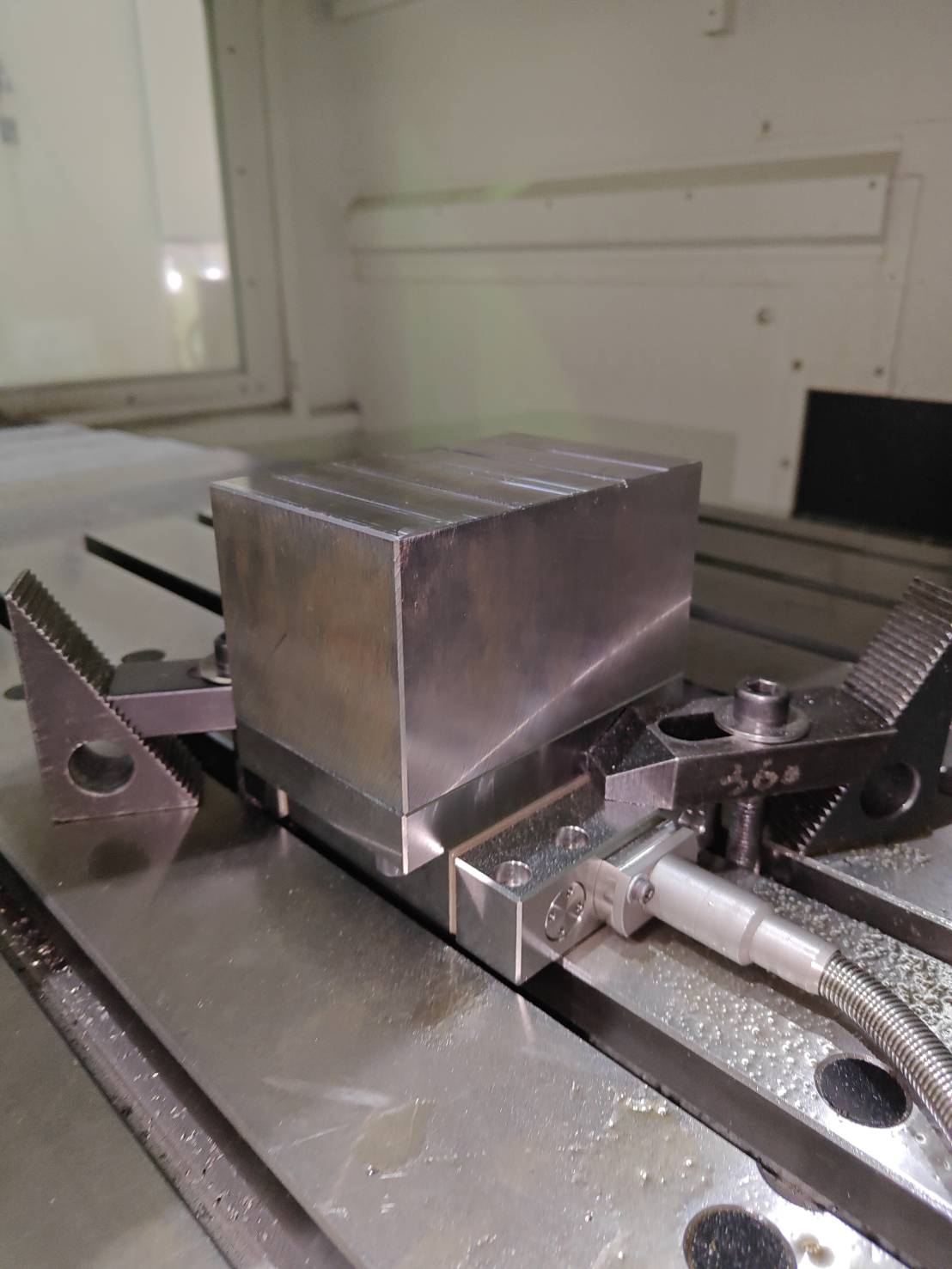
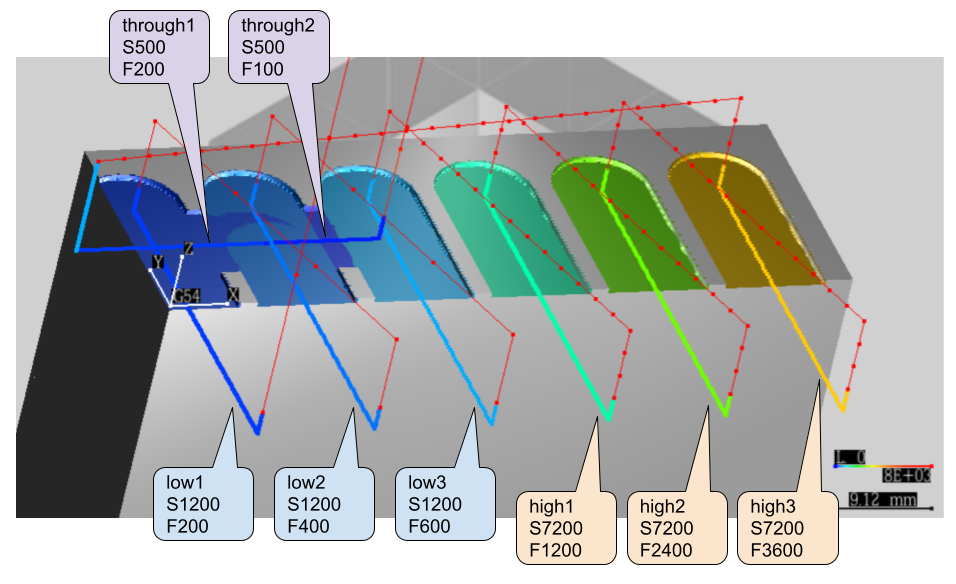
Cutting depth is 0.5 mm.
Toolpath categories are identified by keywords: low, high, through.
“low” denotes low spindle speed, “high” denotes high spindle speed, and “through” denotes a through-pass. There are 8 cuts in total: low1, low2, low3, high1, high2, high3, through1, through2.
If material is limited, low2 and low3 alone are sufficient to complete the training.
low1 intentionally cuts along the edge so that through1 can smoothly enter the cutting zone.
The high series uses the same feed per tooth as the low series but at different spindle speeds, primarily to observe whether spindle speed affects cutting forces. If constrained by material, machine, or other factors, high2 and high3 can be omitted first.
through1 and through2 maintain a constant CWE and serve as validation passes.
If the material is too hard, the cutting depth can be reduced for the experiment.
Experiment Results
The dynamometer data must be retained.