Coolant
Two thermal settings sit beside each other in the equipment tree: how the cutting zone is cooled, and how warm the shop is around it. Both feed the milling-temperature model, so they move computed temperatures and everything downstream of them — and setting them needs no heat-transfer numbers at all, because the cooling types ship as ready-made files.
Where it is
The General Setup page, at /general-setup, reached from the menu bar's Page dropdown.
Background (/general-setup?tree=equipment/background) and Coolant
(/general-setup?tree=equipment/coolant) are two leaves of the Control Tree, sitting together
between Spindle Capability and Fixture. Both are inert until a project is open: the fields are
disabled and the panel says so.
The Coolant leaf selected on a demo project. The panel under the tree opens with the file row — the Select dropdown, the path field reading No coolant file (saved inline), and Save As… — then the read-only Name and Note of whatever file is loaded, and then the condition's own values. Neither leaf puts anything in the middle column.
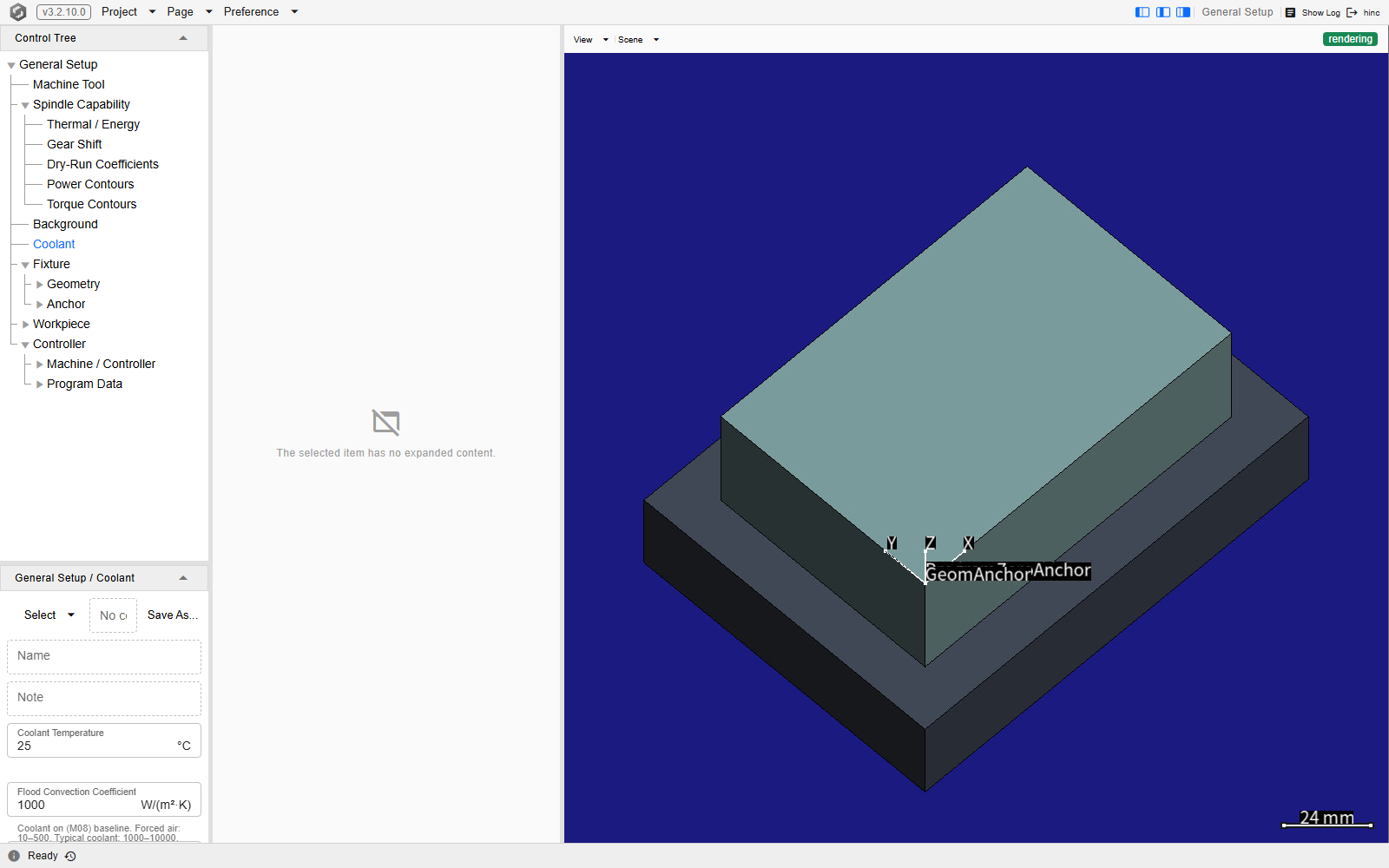
Pick a cooling type
The three standard cooling types ship as ready-made .CoolantHeatCondition files, so picking one
is the cooling-type selection — exactly the way a workpiece material file is picked.
- Select the Coolant leaf.
- Open the Select dropdown at the left of the file row and choose Browse Resource…. It opens the file picker in the shipped library's own coolant folder, so the three files below are what it lists. Browse… above it opens the same picker without that jump, which is how a condition you saved yourself is reached.
- Pick the file that matches the machine.
| Shipped file | Pick it when |
|---|---|
| StandardForcedAir | The machine only blows air at the cutter — no liquid coolant. |
| StandardWaterSolubleCoolant | Water-based emulsion coolant, the common flood coolant. |
| StandardOilBasedCoolant | Neat-oil cutting fluid: better lubrication, noticeably less heat removal than water-based. |
Loading a file fills the read-only Name and Note and every value below them, and reports the name it loaded.
A project nobody has touched here is not neutral. Every project carries a coolant condition from the moment it exists, and it starts on the water-soluble numbers — 25 °C, a flood baseline of 1000 W/(m²·K), a mist ratio of 0.5 and 50 W/(m²·K) with the coolant off. The read-only Name is blank, because no file has been picked, and that blank is the only sign that nobody chose these values. A dry-cutting machine left alone therefore simulates as though it were flooded with water-soluble coolant, and its computed temperatures come out low.
The four values
They are visible whether or not a file is loaded, and editing one tunes this project's copy rather than the file it came from. Each carries the app's own working range as a hint:
| Field | What it is | Range the panel suggests |
|---|---|---|
| Coolant Temperature (°C) | The temperature of the coolant as it arrives at the cut | — |
| Flood Convection Coefficient (W/(m²·K)) | Heat removal with the coolant on | Forced air 10–500; typical liquid coolant 1000–10000 |
| Mist / Flood Ratio | Mist heat removal relative to flood | Typically 0.4–0.8 |
| Off (Air) Convection Coefficient (W/(m²·K)) | Heat removal with the coolant off | Natural air 5–25; forced air inside an enclosure about 50 |
Negative temperatures are accepted, for cryogenic coolant; the three convection coefficients cannot go below zero.
Which of the three coefficients is in force at any moment is not decided here — the NC program's own M07 / M08 / M09 decide it, step by step. That, and what the numbers do to the simulation, are Coolant Model.
Keeping a tuned condition
Save As… writes the current values out as a .CoolantHeatCondition file in the project folder
and starts tracking it, so the project saves a reference to the file instead of a copy of the
values. It offers a name taken from the loaded condition; a file picked from the shipped library
loses its .default marker on the way, because that marker means shipped and a file you saved is
yours.
The result is loadable into the next project through the same Select dropdown — which is the point of saving one: a shop with its own measured coolant performance describes it once.
Background temperature
The Background leaf carries a single field, Background Temperature in °C: the surrounding temperature the thermal model works against. It defaults to 25 °C, it belongs to the project exactly as the coolant condition does, and it is read by the same milling-temperature model and by the feed optimizer, so it is not a display setting.
Set it to the shop's real ambient. There is no file to load and nothing else to configure: one number, applied to the whole project.
See Also
- Coolant Model — the coefficients, the M-code that selects one, the shipped presets and the file format
- Background / Coolant Page — the Control-Tree editor for these values, field by field
- Setup — the rest of the pre-simulation configuration